
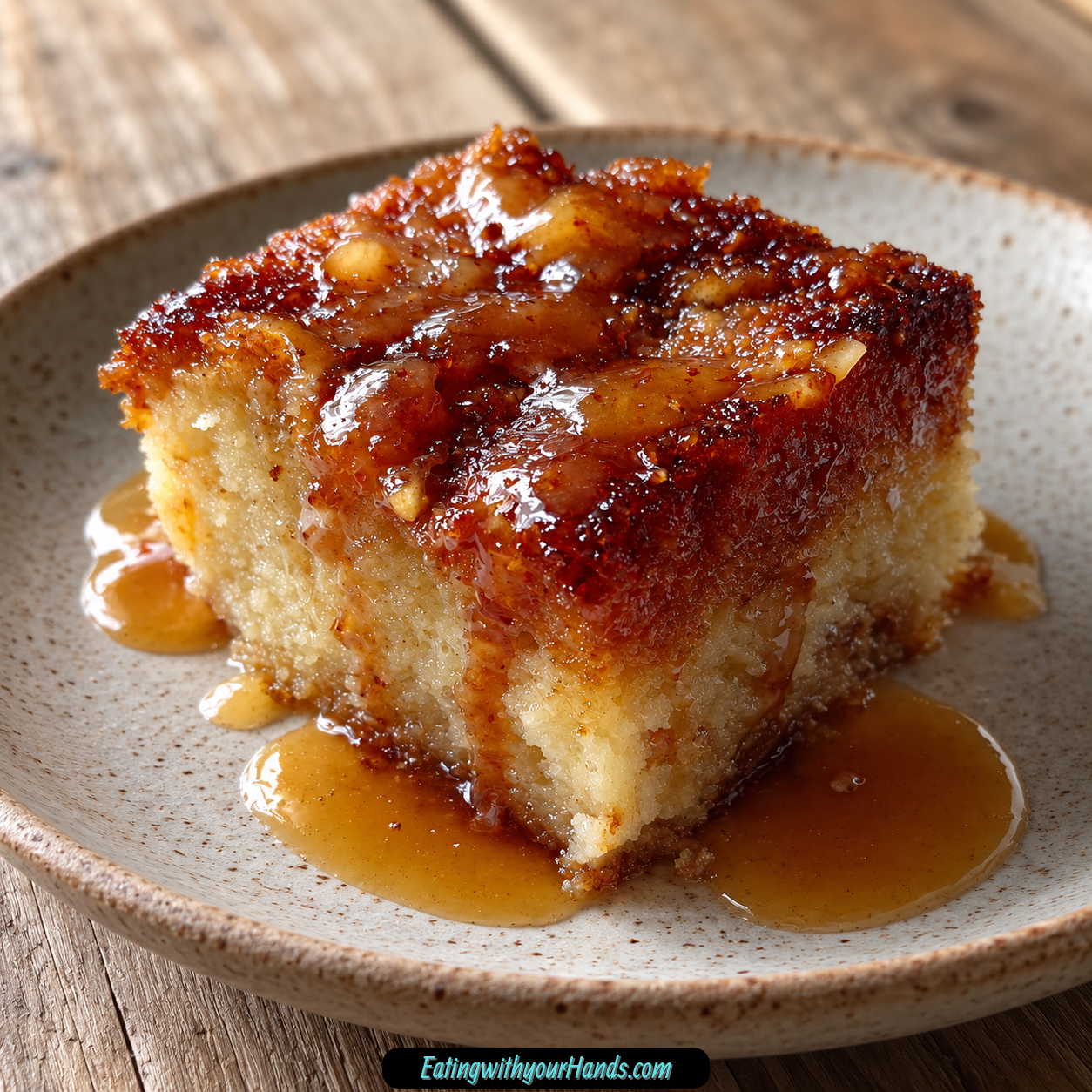
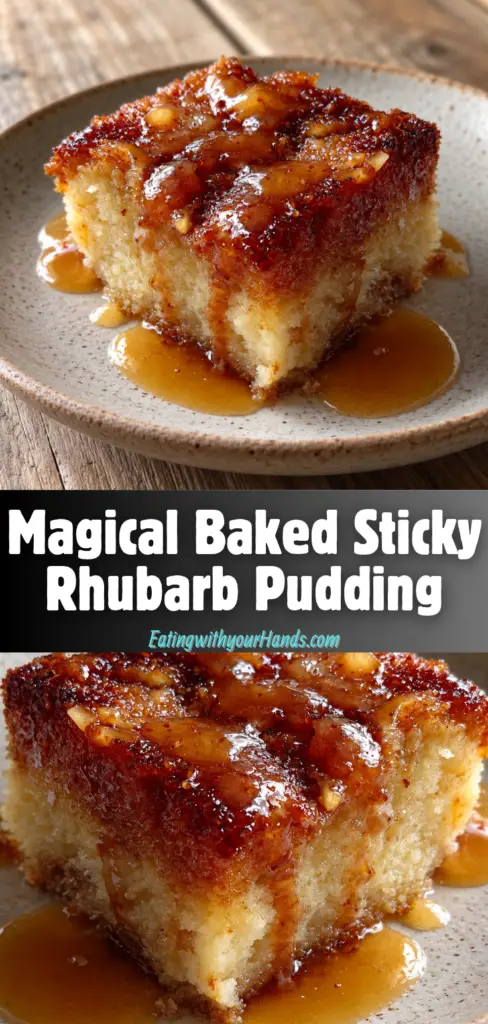
There are desserts I love because they are beautiful, and there are desserts I love because one warm spoonful can bring back an entire season of memories. This Baked Sticky Rhubarb Pudding belongs completely to the second group for me.
It has that wonderful kind of old-fashioned comfort that never needs elaborate decoration to feel special. Tangy rhubarb softens into a sweet, jammy layer beneath a tender vanilla pudding, while a warm cream-and-corn-syrup glaze sinks into the golden top and gives the whole dessert its signature sticky finish.
The contrast is what gets me every time. The rhubarb stays bright and tart enough to keep the dessert from tasting flat, while brown sugar, butter, vanilla, and the warm glaze wrap everything in a richer sweetness.
Serve it while it is still warm and the experience gets even better. A scoop of vanilla ice cream begins melting over the top, the sticky glaze runs around the edges, and the combination somehow feels both rustic and completely indulgent.
For me, though, this dessert has always been about more than the first bite.
I grew up with a rhubarb patch in the backyard that somehow survived despite my mom’s less-than-perfect gardening skills. Every spring, the appearance of those first bright stalks felt like a little announcement that this pudding would not be far behind.
We would rush outside to pick them while they were ready, already thinking about what would happen once the rhubarb reached the kitchen. The smell of sugar and rhubarb bubbling together in the oven became one of those aromas that lodged itself permanently in my memory.
Even now, it takes me straight back to slow spring afternoons.
Over the years, I adjusted the recipe, made mistakes, baked versions that were not quite right, and learned where the balance mattered most. The version I return to now has the tender crumb I wanted, enough rhubarb tang to keep each bite lively, and a warm sticky topping that settles into the pudding after baking.
It is simple enough to make without turning an ordinary evening into a baking project. At the same time, it has enough character to bring to a table when guests are coming over and you want dessert to feel memorable.
The hardest part may honestly be the final wait. Once the glaze is poured over that hot golden pudding, you need to leave it alone for 10 minutes before serving, and those 10 minutes can feel remarkably long when the whole kitchen smells like warm rhubarb and caramelized sugar.
Table of Contents
- Why Baked Sticky Rhubarb Pudding Is So Hard to Resist
- Ingredients for Baked Sticky Rhubarb Pudding
- Equipment You’ll Need
- Preparing the Rhubarb
- How to Make Magical Baked Sticky Rhubarb Pudding
- Step 1: Preheat the Oven
- Step 2: Prepare the Baking Dish
- Step 3: Chop and Measure the Rhubarb
- Step 4: Add the Granulated Sugar
- Step 5: Add the Lemon Juice
- Step 6: Let the Rhubarb Rest for 10 Minutes
- Step 7: Taste for Tartness if Desired
- Step 8: Soften the Butter Properly
- Step 9: Cream the Butter and Brown Sugar
- Step 10: Add the Vanilla
- Step 11: Add the Room-Temperature Egg
- Step 12: Combine the Dry Ingredients
- Step 13: Begin Adding the Dry Ingredients
- Step 14: Add Some of the Milk
- Step 15: Continue Alternating Flour and Milk
- Step 16: Stop Mixing as Soon as Combined
- Step 17: Transfer the Rhubarb to the Baking Dish
- Step 18: Add the Pudding Batter
- Step 19: Place the Dish on the Baking Sheet
- Step 20: Bake at 350°F for 45 Minutes
- Step 21: Check the Center Carefully
- Step 22: Use the Additional Doneness Cues
- Step 23: Start the Glaze Near the End of Baking
- Step 24: Heat the Glaze Without Boiling
- Step 25: Pour the Glaze Over the Hot Pudding
- Step 26: Let the Glaze Settle Into the Pudding
- Step 27: Serve Warm
- Why the 10-Minute Rhubarb Rest Matters
- Why the Second 10-Minute Wait Matters Even More
- How to Know When the Pudding Is Fully Baked
- Tips for the Best Baked Sticky Rhubarb Pudding
- Using Frozen Rhubarb
- Adding Strawberries
- Using Green Apples Instead of Rhubarb
- Corn Syrup Substitutions
- Butter Substitutions
- Brown Sugar Substitutions
- Do Not Skip the Lemon Juice
- Serving Suggestions
- How to Store Baked Sticky Rhubarb Pudding
- How to Reheat Individual Portions
- How to Reheat Larger Portions
- Do Not Add Extra Liquid to Chilled Glaze
- How to Make the Pudding Ahead
- Frequently Asked Questions
- Can I use frozen rhubarb?
- Why is my pudding soggy underneath?
- Can I make it ahead?
- How long do leftovers keep?
- Can I replace the corn syrup?
- Can I use salted butter?
- Can I make it vegan?
- Can I use 2% milk?
- Can I use white sugar instead of brown sugar?
- Do I really need the lemon juice?
- How do I tell when the pudding is done?
- Nutritional Information
- The Dessert That Still Smells Like Spring to Me
- Magical Baked Sticky Rhubarb Pudding Recipe
Why Baked Sticky Rhubarb Pudding Is So Hard to Resist
The sweet-tart balance is the first reason this dessert works so well.
Rhubarb has a sharp flavor that does not disappear simply because sugar is added. Instead, the 1 cup granulated sugar softens that tartness while still allowing the fruit to taste distinctly like rhubarb.
Lemon juice keeps the filling bright. It may seem unusual to add acidity to an already tart ingredient, but in this recipe the lemon is part of the flavor balance and should not be skipped.
Then there is the pudding layer.
Brown sugar gives the batter a deeper sweetness than plain granulated sugar would, while butter and whole milk keep the crumb rich. Vanilla rounds everything out so the cake-like portion stays comforting rather than competing with the rhubarb.
The finishing glaze changes the dessert again.
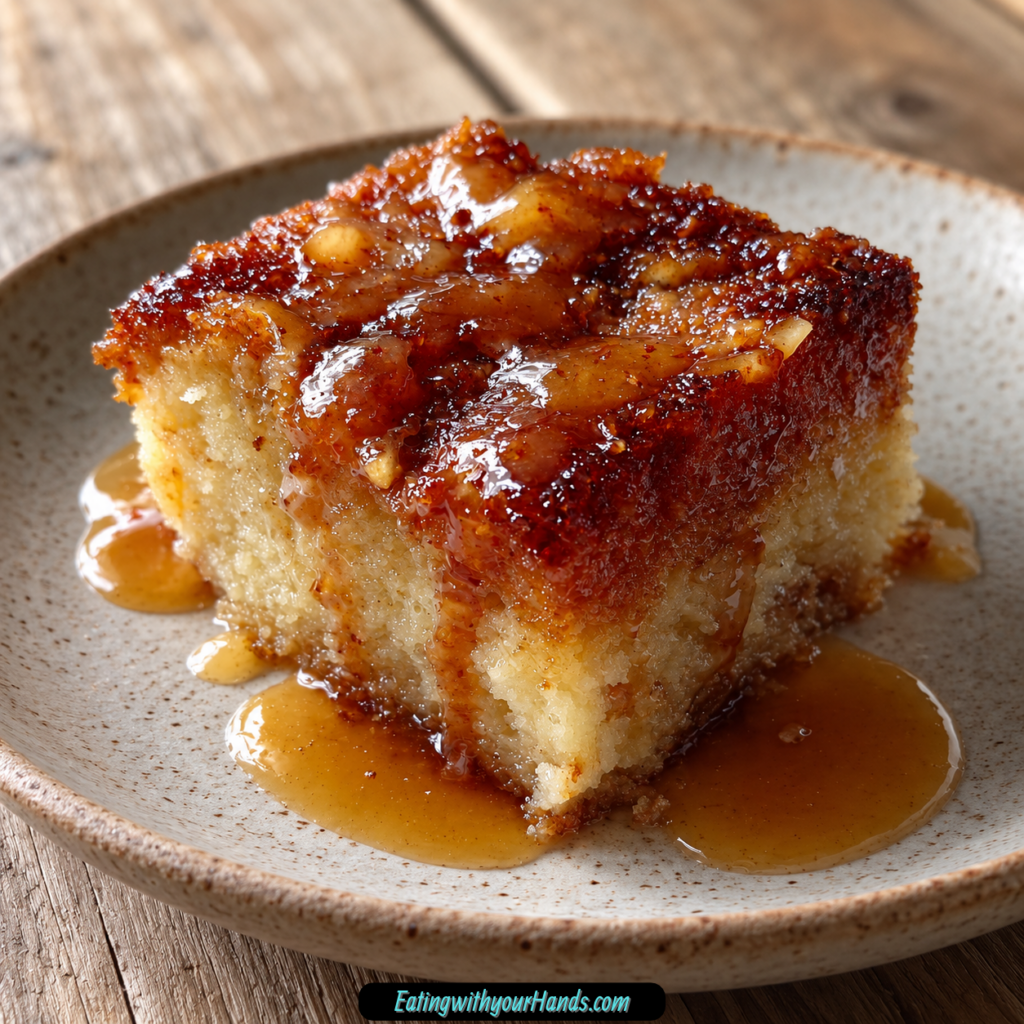
Heavy cream and light corn syrup are gently warmed together and poured over the pudding while it is still hot from the oven. That warm mixture seeps into the top and settles into the cracks and edges, giving the dessert the glossy, sticky quality that makes it feel so indulgent.
It is also a very approachable dessert.
There is no complicated shaping, no delicate pastry, and no intricate decorating. You prepare the rhubarb, mix the batter, layer everything into a baking dish, bake, pour over the glaze, and wait.
That is a large part of the charm.
Ingredients for Baked Sticky Rhubarb Pudding
The ingredient list is divided into three simple parts: the rhubarb layer, the pudding batter, and the sticky glaze.
For the Rhubarb Layer
- 4 cups fresh rhubarb, chopped into ½-inch pieces, about 6–8 stalks
- 1 cup granulated sugar
- 1 tablespoon lemon juice
Measure the rhubarb after chopping it.
If your rhubarb is especially tart, the sugar can be increased by another ¼ cup according to taste.
For the Pudding Batter
- ½ cup unsalted butter, softened at room temperature
- 1 cup brown sugar, packed firmly
- 1 teaspoon vanilla extract
- 1 large egg, at room temperature
- 1 ½ cups all-purpose flour, spooned and leveled
- 1 teaspoon baking powder
- ½ teaspoon salt
- 1 cup whole milk
Dark brown sugar is especially good when you want stronger caramel notes.
Two-percent milk can work in a pinch, although whole milk gives the richer result.
For the Sticky Glaze
- ½ cup heavy cream
- ¼ cup light corn syrup
The corn syrup is what gives the glaze its glossy, clingy texture.
Warm it gently with the cream rather than boiling it.
Equipment You’ll Need
You only need a few basic tools:
- 9×9-inch baking dish, or something similar
- 2 mixing bowls
- Whisk
- Spatula
- Small saucepan
A baking sheet placed underneath the baking dish is also strongly recommended.
Rhubarb juices can bubble up during baking, and the sheet underneath can catch any overflow before it creates a smoky mess in the oven.
If you use a deeper baking dish than the standard 9×9-inch size, the baking time may need adjustment.
Preparing the Rhubarb
Use 4 cups fresh rhubarb chopped into ½-inch pieces.
Fresh rhubarb is ideal because the firm stalks soften beautifully during baking without starting excessively wet.
Cutting the stalks into fairly even pieces helps them cook at a similar rate.
You want the rhubarb to soften into a jammy layer, not leave some pieces firm while others completely disappear.
If the stalks look pale and you want more color, a handful of strawberries can be added.
The pudding works perfectly well without them, so consider this an optional variation rather than a required ingredient.
How to Make Magical Baked Sticky Rhubarb Pudding
The recipe is easiest when you work in stages. Start the rhubarb first so it can sit for at least 10 minutes while you prepare the pudding batter.
Step 1: Preheat the Oven
Set the oven to 350°F.
Let it fully preheat before the assembled pudding goes inside.
A properly heated oven matters because the batter needs to begin baking immediately rather than slowly warming from a cold start.
This is especially important for avoiding an overly wet bottom.
Step 2: Prepare the Baking Dish
Grease a 9×9-inch baking dish.
Make sure the bottom and sides are lightly coated.
Set the prepared dish on a baking sheet before you begin filling it.
That extra sheet acts as insurance against bubbling rhubarb juices escaping during baking.
Step 3: Chop and Measure the Rhubarb
Trim and chop the fresh rhubarb into ½-inch pieces.
Measure 4 cups after chopping.
This is an important detail because measuring the stalks before cutting can give you a different quantity.
Transfer the chopped rhubarb to a mixing bowl.
Step 4: Add the Granulated Sugar
Sprinkle 1 cup granulated sugar over the rhubarb.
Stir so the sugar reaches as many pieces as possible.
You may hear the dry sugar scrape and crunch against the fresh stalks at first.
That texture will begin changing as the rhubarb releases juice.
Step 5: Add the Lemon Juice
Pour 1 tablespoon lemon juice over the sugared rhubarb.
Stir again.
The lemon is part of the flavor balance and should not be skipped.
Even though rhubarb itself is tart, the lemon keeps the sweetness bright rather than heavy.
Step 6: Let the Rhubarb Rest for 10 Minutes
Leave the rhubarb mixture alone for at least 10 minutes.
During this time, the sugar begins drawing liquid from the chopped stalks.
You should start seeing syrup collecting at the bottom of the bowl.
Do not drain that liquid.
It will all go into the baking dish and becomes part of the sticky fruit layer.
Step 7: Taste for Tartness if Desired
Rhubarb varies in sharpness.
If you want to assess yours, taste a small piece before baking.
If it is extremely tart, the rhubarb layer can take another ¼ cup sugar.
Make that adjustment now rather than trying to sweeten the baked dessert later.
Step 8: Soften the Butter Properly
Measure ½ cup unsalted butter and make sure it is softened at room temperature.
The butter should be soft enough to cream with the sugar but not melted.
Avoid using the microwave simply to liquefy it.
Melted butter changes the texture of the batter and does not behave the same way as properly softened butter.
Step 9: Cream the Butter and Brown Sugar
In your second mixing bowl, combine the softened butter with 1 cup firmly packed brown sugar.
Cream them together until the mixture looks lighter and fluffy.
Dark brown sugar can be used when you want a stronger caramel note.
Take enough time for the butter and sugar to blend thoroughly before adding the egg.
Step 10: Add the Vanilla
Pour in 1 teaspoon vanilla extract.
Mix just until distributed.
The vanilla gives the pudding base its warm background flavor.
It should complement the rhubarb rather than dominate it.
Step 11: Add the Room-Temperature Egg
Add 1 large room-temperature egg.
Mix only until it disappears into the butter mixture.
Avoid prolonged beating.
The goal at this stage is an even batter base, not excessive aeration.
Step 12: Combine the Dry Ingredients
In a separate bowl, whisk together 1 ½ cups all-purpose flour, 1 teaspoon baking powder, and ½ teaspoon salt.
The flour should be spooned into the measuring cup and leveled rather than packed down.
Whisking distributes the baking powder and salt evenly.
This helps the batter bake more consistently.
Step 13: Begin Adding the Dry Ingredients
Add part of the flour mixture to the butter mixture.
Stir gently.
Do not add everything all at once because the method works best when the flour and milk are incorporated gradually.
The process should start with dry ingredients and finish with dry ingredients.
Step 14: Add Some of the Milk
Pour in part of the 1 cup whole milk.
Mix gently until it is mostly incorporated.
The batter will loosen.
Whole milk gives the richest version, although 2% milk is an allowed substitute when necessary.
Step 15: Continue Alternating Flour and Milk
Add another portion of the flour mixture.
Then add more milk.
Continue alternating until all the ingredients have been used.
Finish with the dry ingredients.
This gradual method makes it easier to create an even batter without overworking it.
Step 16: Stop Mixing as Soon as Combined
Stir only until the flour has disappeared.
A few small lumps are completely fine.
Do not try to create an ultra-smooth batter.
Overmixing can make the pudding tougher rather than tender.
Once everything is combined, stop.
Step 17: Transfer the Rhubarb to the Baking Dish
Pour the entire rhubarb mixture into the greased baking dish.
Include every bit of liquid that accumulated during the 10-minute rest.
Spread the rhubarb into a reasonably even layer.
That syrupy liquid is part of the dessert, not something to discard.
Step 18: Add the Pudding Batter
Spoon or dollop the batter over the rhubarb.
Work across the surface rather than placing all the batter in one area.
Use a spatula to spread it gently.
It is completely fine if a little rhubarb remains visible through the batter.
Step 19: Place the Dish on the Baking Sheet
Make sure the baking dish is sitting on the extra baking sheet.
This step is especially useful once the rhubarb begins bubbling.
The juices can rise around the edges during baking.
Catching overflow on a sheet is much easier than cleaning burned fruit syrup from the bottom of the oven.
Step 20: Bake at 350°F for 45 Minutes
Place the pudding in the fully preheated oven.
Bake for 45 minutes.
The top should become golden.
The dessert should also look set rather than visibly wet across the center.
Do not rely on color alone, because the rhubarb underneath can keep the center moister than the edges.
Step 21: Check the Center Carefully
Insert a toothpick near the center.
You are looking for moist crumbs rather than raw, wet batter.
A few sticky rhubarb bits on the toothpick are perfectly acceptable.
Also look at the edges.
They should begin pulling very slightly away from the pan.
Step 22: Use the Additional Doneness Cues
The toothpick is useful, but do not treat it as the only clue.
Press the top gently and listen.
A properly baked pudding may make small bubbling sounds beneath the surface.
The combination of a golden top, moist crumbs rather than wet batter, and slightly pulling edges gives you a much better picture of doneness.
Step 23: Start the Glaze Near the End of Baking
While the pudding finishes, add ½ cup heavy cream to a small saucepan.
Add ¼ cup light corn syrup.
Place the saucepan over low heat.
Stir gently as the ingredients warm together.
Step 24: Heat the Glaze Without Boiling
Warm the cream and corn syrup until the mixture is steaming.
Do not let it boil.
The purpose is simply to create a warm, fluid glaze.
Keep the heat low and controlled.
Once it is hot and smooth, it is ready.
Step 25: Pour the Glaze Over the Hot Pudding
As soon as the pudding comes out of the oven, pour the warm glaze evenly over the top.
Work across the entire surface.
The hot pudding will absorb some of the mixture immediately.
You may hear a gentle sizzle as it reaches the surface and edges.
Step 26: Let the Glaze Settle Into the Pudding
Do not serve immediately.
Leave the glazed pudding undisturbed for a full 10 minutes.
This waiting period allows the creamy syrup to sink into the pudding and create the sticky texture that defines the dessert.
It also gives the extremely hot fruit and sugar mixture time to cool slightly.
Step 27: Serve Warm
After the 10-minute rest, spoon the pudding directly from the dish or cut portions more neatly if you prefer.
Make sure each serving gets some rhubarb from the bottom and sticky topping from the surface.
Serve warm.
Vanilla ice cream or freshly whipped cream are the favorite accompaniments.
Why the 10-Minute Rhubarb Rest Matters
The first 10-minute rest happens before baking.
Sugar begins pulling juice from the chopped rhubarb, creating a syrupy mixture before the dish ever goes into the oven.
That liquid becomes part of the fruit layer.
Do not rush the step simply because the rhubarb already looks coated with sugar.
It is also one of the tips given for avoiding an overly soggy final texture.
Let the fruit have its full macerating time while you make the batter.
Why the Second 10-Minute Wait Matters Even More
The second 10-minute rest happens after the pudding has baked and the glaze has been poured over the top.
This wait is essential.
The hot pudding needs time to absorb the cream-and-corn-syrup mixture.
Cut too early and the sticky liquid can run everywhere instead of settling into the dessert.
The waiting time also reduces the risk of digging immediately into dangerously hot sugar and fruit.
Use those minutes to scoop ice cream, whip cream, or simply stand in the kitchen enjoying the smell.
How to Know When the Pudding Is Fully Baked
The toothpick test needs a little interpretation with a fruit dessert.
If the pick comes out covered in raw batter, the pudding is not ready.
Moist crumbs are fine.
Sticky rhubarb is also fine because the fruit layer underneath is supposed to stay soft and jammy.
Check the edges as well.
A slight pull away from the pan is another good sign.
The top should also look golden and set.
Together, those signs are more useful than expecting a perfectly dry toothpick.
Tips for the Best Baked Sticky Rhubarb Pudding
A handful of small details can make the dessert more reliable.
Adjust the Sugar for Your Rhubarb
Rhubarb does not taste identical from one batch to another.
Some stalks are extremely tart.
Taste yours before mixing if you are comfortable doing so.
If the flavor is very sharp, increase the sugar in the rhubarb layer by ¼ cup.
Make Sure the Oven Is Fully Preheated
Do not put the pudding into a cold or partially heated oven.
A fully preheated 350°F oven helps the batter begin setting immediately.
This is one of the suggested ways to prevent an excessively wet bottom.
Do Not Overmix the Batter
Once the dry ingredients and milk go into the butter mixture, use a gentle hand.
Stop once combined.
A few lumps are preferable to a batter that has been worked until completely smooth.
Use a Baking Sheet Underneath
Rhubarb releases plenty of liquid as it cooks.
That juice can bubble up around the edges.
A baking sheet underneath prevents a small overflow from turning into a smoky oven problem.
Respect the Final Rest
The 10 minutes after glazing are not decorative.
They are part of the recipe.
Let the pudding absorb the sticky glaze before serving.
Using Frozen Rhubarb
Fresh rhubarb is the preferred option, but frozen works in a pinch.
Thaw it completely first.
Drain excess liquid thoroughly.
Pat the thawed pieces dry with paper towels if needed.
Then toss the rhubarb with 1 extra tablespoon flour before combining it with the sugar.
That added flour is specifically suggested to help manage lingering moisture.
Continue with the remaining preparation from there.
Adding Strawberries
If the rhubarb looks pale and you want more color, add a handful of strawberries.
They are optional.
The recipe does not require strawberries to achieve the intended texture or flavor.
Think of them as a supporting addition rather than a replacement for the 4 cups rhubarb.
No exact strawberry quantity is provided beyond a handful.
Using Green Apples Instead of Rhubarb
If rhubarb is unavailable entirely, tart green apples can be used as an alternative.
Peel them and slice them thin.
Add a little more lemon juice than usual.
This variation will not taste the same as rhubarb pudding.
It is simply a practical way to adapt the overall dessert idea when rhubarb is not an option.
Corn Syrup Substitutions
Light corn syrup gives the glaze its neutral sweetness and sticky, glossy quality.
If you prefer not to use it, maple syrup can be substituted.
Honey is another option.
Golden syrup can also work.
Each of these will bring a more distinct flavor than light corn syrup.
Whichever you choose, warm it gently with the heavy cream.
Avoid aggressive heat.
Butter Substitutions
If unsalted butter is unavailable, regular salted butter can be used.
In that case, omit the added ½ teaspoon salt from the batter.
Vegan butter is another possible substitution.
Expect the finished pudding to have a slightly denser texture.
Keep the measurement at ½ cup.
Brown Sugar Substitutions
White sugar can replace brown sugar in a pinch.
The pudding will lose some of the deeper caramel character that brown sugar contributes.
Coconut sugar is another option.
It gives the dessert a more earthy flavor.
Avoid replacing the brown sugar in the batter with liquid sweeteners.
That kind of substitution changes the moisture balance and can interfere with the texture.
Do Not Skip the Lemon Juice
The rhubarb layer uses 1 tablespoon lemon juice.
Bottled juice is acceptable if fresh lemon is unavailable.
This is one ingredient the recipe specifically recommends keeping.
It balances the sweetness and supports the bright tart character of the rhubarb.
Serving Suggestions
This pudding is at its best warm.
A scoop of vanilla ice cream is the classic pairing.
Place it on top while the pudding is still warm enough to soften the edges of the ice cream.
The cold vanilla and hot sticky rhubarb create exactly the kind of contrast that makes the dessert feel especially comforting.
Freshly whipped cream is another favorite.
A generous dollop melts more slowly than ice cream but still adds a cool, creamy element.
If some glaze collects in the baking dish, spoon it over each serving.
That extra drizzle is too good to leave behind.
How to Store Baked Sticky Rhubarb Pudding
Let leftovers cool.
Cover the baking dish tightly with foil or transfer individual portions to an airtight container.
Refrigerate for up to 3 days.
The glaze may lose some of its shine by the second day.
That does not mean the pudding has gone wrong.
The chilled glaze also becomes firmer.
It loosens again once the dessert is warmed.
How to Reheat Individual Portions
Place one serving in the microwave.
Cover the top with a damp paper towel.
Microwave for 20–30 seconds.
The steam helps restore the soft, sticky texture.
Check the temperature before eating because the fruit layer can become hot quickly.
How to Reheat Larger Portions
For a bigger piece or several servings, use the oven.
Set the oven to 300°F.
Cover the pudding with foil.
Warm for about 10 minutes.
Covering prevents the dessert from drying out while it heats.
A tiny pat of butter on top before reheating is also suggested for a freshly baked feel.
Do Not Add Extra Liquid to Chilled Glaze
The glaze naturally firms when refrigerated.
Do not assume it needs to be thinned.
Heat will loosen it again.
Simply reheat the pudding gently and let the glaze soften on its own.
Adding unnecessary liquid can change the intended sticky texture.
How to Make the Pudding Ahead
The pudding can be assembled without the glaze up to 1 day in advance.
Cover the prepared dish and refrigerate it.
When you are ready to bake, remove it from the refrigerator.
Let it sit at room temperature for 30 minutes while the oven preheats.
Then bake as directed.
The glaze should be prepared fresh.
It only takes a short time to warm the heavy cream and corn syrup together.
Pour it over the pudding immediately after baking.
Frequently Asked Questions
Can I use frozen rhubarb?
Yes.
Thaw it completely and remove excess moisture.
Pat it dry if necessary.
Toss the thawed rhubarb with 1 extra tablespoon flour before mixing it with the sugar.
This helps handle the additional moisture frozen fruit may carry.
Why is my pudding soggy underneath?
Make sure the rhubarb sits with the sugar and lemon for the full 10 minutes before assembly.
Also make sure the oven is completely preheated to 350°F before the pudding goes inside.
After baking and glazing, let the dessert sit for the full 10 minutes before serving.
That resting period gives steam and the sticky glaze time to settle rather than flooding out immediately when the pudding is cut.
Can I make it ahead?
Yes.
Assemble the pudding without the glaze up to 1 day in advance.
Cover and refrigerate.
Before baking, let the dish sit at room temperature for 30 minutes while the oven preheats.
Bake as directed.
Make the glaze fresh and pour it over the hot pudding after baking.
How long do leftovers keep?
Store them covered in the refrigerator for up to 3 days.
Reheat individual portions in the microwave or larger amounts in the oven.
Can I replace the corn syrup?
Yes.
Maple syrup, honey, or golden syrup can be used.
Expect each one to bring more of its own flavor than the neutral light corn syrup.
Can I use salted butter?
Yes.
Use the same amount of butter.
Omit the ½ teaspoon salt from the batter.
Can I make it vegan?
Vegan butter is listed as an allowed butter substitute, although the finished texture may be slightly denser.
No complete vegan replacements are provided for the egg, whole milk, or heavy cream, so no full vegan version is specified.
Can I use 2% milk?
Yes.
Whole milk is preferred for the richest pudding.
Two-percent milk works in a pinch.
Can I use white sugar instead of brown sugar?
Yes.
The pudding will lose some caramel depth.
Coconut sugar is another possible substitute with a more earthy flavor.
Do I really need the lemon juice?
Yes.
The lemon juice is specifically treated as an important part of the rhubarb layer.
Bottled lemon juice is acceptable if needed.
How do I tell when the pudding is done?
Look for a golden top.
A toothpick inserted near the center should show moist crumbs rather than wet batter.
A few sticky rhubarb pieces are fine.
The edges should also pull away slightly from the pan.
Nutritional Information
The following values are estimates per serving:
- Calories: 320
- Fat: 12g
- Carbohydrates: 52g
- Fiber: 2g
- Protein: 4g
The butter and cream contribute much of the fat.
The egg and milk contribute some of the protein, while rhubarb contributes some fiber.
Exact nutrition will vary according to ingredient brands and any substitutions.
Changing the sugars, dairy products, fruit, or glaze sweetener will also change the final values.
The Dessert That Still Smells Like Spring to Me
I do not think I will ever bake this pudding without remembering that old backyard rhubarb patch.
It was not a particularly glamorous garden, and the rhubarb certainly did not owe its survival to expert care. Somehow, though, those stalks came back and gave us something to look forward to every spring.
Picking the first ones felt like a tiny family event.
We knew what they meant.
Soon there would be sugar in a bowl with chopped rhubarb, butter softening on the counter, and that unmistakable smell coming from the oven.
Years later, I have made plenty of more polished desserts.
Still, few of them create the same feeling as pulling this pudding from the oven and watching the glaze disappear slowly into its golden surface.
Maybe that is why I stopped trying to make it too perfect.
The rhubarb can peek through the top.
The glaze can gather around the edges.
A spoonful may collapse slightly when it lands on the plate, especially while it is warm.
None of that makes the dessert less appealing.
If anything, those details are part of why it feels so comforting.
This is the sort of pudding that belongs in a baking dish in the middle of a table, still warm enough for vanilla ice cream to begin melting the moment it touches the surface.
It is also the kind of recipe that can turn an ordinary Tuesday into something worth remembering.
The combination remains wonderfully simple: tart rhubarb, a soft buttery pudding, brown sugar, vanilla, and a warm sticky glaze.
Yet every time I taste it, the result feels bigger than that list suggests.
I still have to talk myself through the final 10-minute wait.
The dessert comes out bubbling, the glaze goes on, and every instinct says to grab a spoon immediately.
But I wait.
Then, when the glaze has settled and the first warm serving comes out with that jammy rhubarb underneath, I remember exactly why this is the version I keep coming back to.
Magical Baked Sticky Rhubarb Pudding Recipe
Sweet, tangy, soft, and wonderfully comforting, this Magical Baked Sticky Rhubarb Pudding layers tart rhubarb beneath a tender brown sugar batter before finishing everything with a warm cream and corn syrup soak. The result is a cozy American dessert with juicy fruit, a soft baked center, and a rich sticky finish.
Recipe Details
- Prep Time: 15 minutes
- Cook Time: 45 minutes
- Total Time: 1 hour
- Course: Dessert
- Cuisine: American
- Servings: 8 servings
- Calories: 320 kcal
Ingredients
For the Rhubarb Layer
- 1 tablespoon lemon juice
- 1 cup granulated sugar
- 4 cups rhubarb chopped
For the Pudding Batter
- 1 cup milk
- ½ teaspoon salt
- 1 teaspoon baking powder
- 1 ½ cups all-purpose flour
- 1 large egg
- 1 teaspoon vanilla extract
- 1 cup brown sugar packed
- ½ cup unsalted butter softened
For the Sticky Cream Topping
- ¼ cup light corn syrup
- ½ cup heavy cream
Instructions
Step 1: Preheat the Oven
Preheat the oven to 350°F (175°C).
Have a baking dish ready while you prepare the rhubarb and pudding batter.
Step 2: Prepare the Rhubarb
In a bowl, combine the chopped rhubarb, granulated sugar, and lemon juice.
Mix gently until the rhubarb is coated, then set the mixture aside.
Step 3: Cream the Butter and Brown Sugar
In another bowl, beat the softened unsalted butter, packed brown sugar, and vanilla extract together.
Continue mixing until the ingredients are creamy and well combined.
Step 4: Add the Egg
Beat the large egg into the butter mixture.
Mix until fully incorporated.
Step 5: Combine the Dry Ingredients
In a separate bowl, mix the all-purpose flour, baking powder, and salt.
Stir until the dry ingredients are evenly distributed.
Step 6: Finish the Batter
Alternate adding the flour mixture and milk to the butter mixture.
Mix well after the additions until a smooth batter forms.
Step 7: Layer the Pudding
Spread the prepared rhubarb mixture evenly in the baking dish.
Pour the batter over the rhubarb, covering the fruit layer as evenly as possible.
Step 8: Bake
Bake for 45 minutes.
Remove the pudding from the oven once the baking time is complete.
Step 9: Prepare the Sticky Cream Mixture
Add the heavy cream and light corn syrup to a saucepan.
Heat until warm, stirring as needed.
Step 10: Soak the Pudding
Pour the warm heavy cream and corn syrup mixture over the baked pudding.
Let it soak for 10 minutes so the topping can absorb into the warm dessert.
Step 11: Serve Warm
Serve the pudding warm after the 10-minute soaking period.
Divide into 8 servings.
Notes
- Use fresh rhubarb for best results.
- Adjust sugar based on rhubarb tartness.
- Serve with ice cream or whipped cream if desired.
Serving Suggestions
Serve Magical Baked Sticky Rhubarb Pudding warm after the cream and corn syrup mixture has soaked into the baked dessert for 10 minutes. The tangy rhubarb, brown sugar batter, and warm sticky topping create a soft, rich dessert with plenty of contrast between sweet and tart flavors.
This recipe makes 8 servings, making it a good choice for a family dessert or casual gathering.
Use fresh rhubarb for the best result as noted, and adjust the sugar according to the tartness of the fruit. Ice cream or whipped cream can be added when serving if desired.
Storage
How to Store
The recipe does not provide a specific storage method or storage duration, so no exact storage time is added here.
Rhubarb Tip
Use 4 cups chopped rhubarb.
Combine it with 1 cup granulated sugar and 1 tablespoon lemon juice before spreading it in the baking dish.
Butter Tip
Use ½ cup softened unsalted butter and cream it with the packed brown sugar and vanilla extract.
Brown Sugar Tip
Use 1 cup packed brown sugar in the pudding batter.
Flour Tip
Use 1 ½ cups all-purpose flour with 1 teaspoon baking powder and ½ teaspoon salt.
Milk Tip
Use 1 cup milk and alternate it with the flour mixture while finishing the batter.
Sticky Topping Tip
Warm ½ cup heavy cream with ¼ cup light corn syrup in a saucepan.
Pour the mixture over the baked pudding and allow it to soak for 10 minutes.
Baking Tip
Bake at 350°F (175°C) for 45 minutes.
Serving Tip
Serve warm with ice cream or whipped cream if desired.

Fernando is the creator and writer behind the food blog Eating with your Hands. Living and working in cities like Paris, Barcelona, and Berlin, and being married to a Canadian foodie, has given Fernando a passion and interest in food and inspired him to run EWYH.