
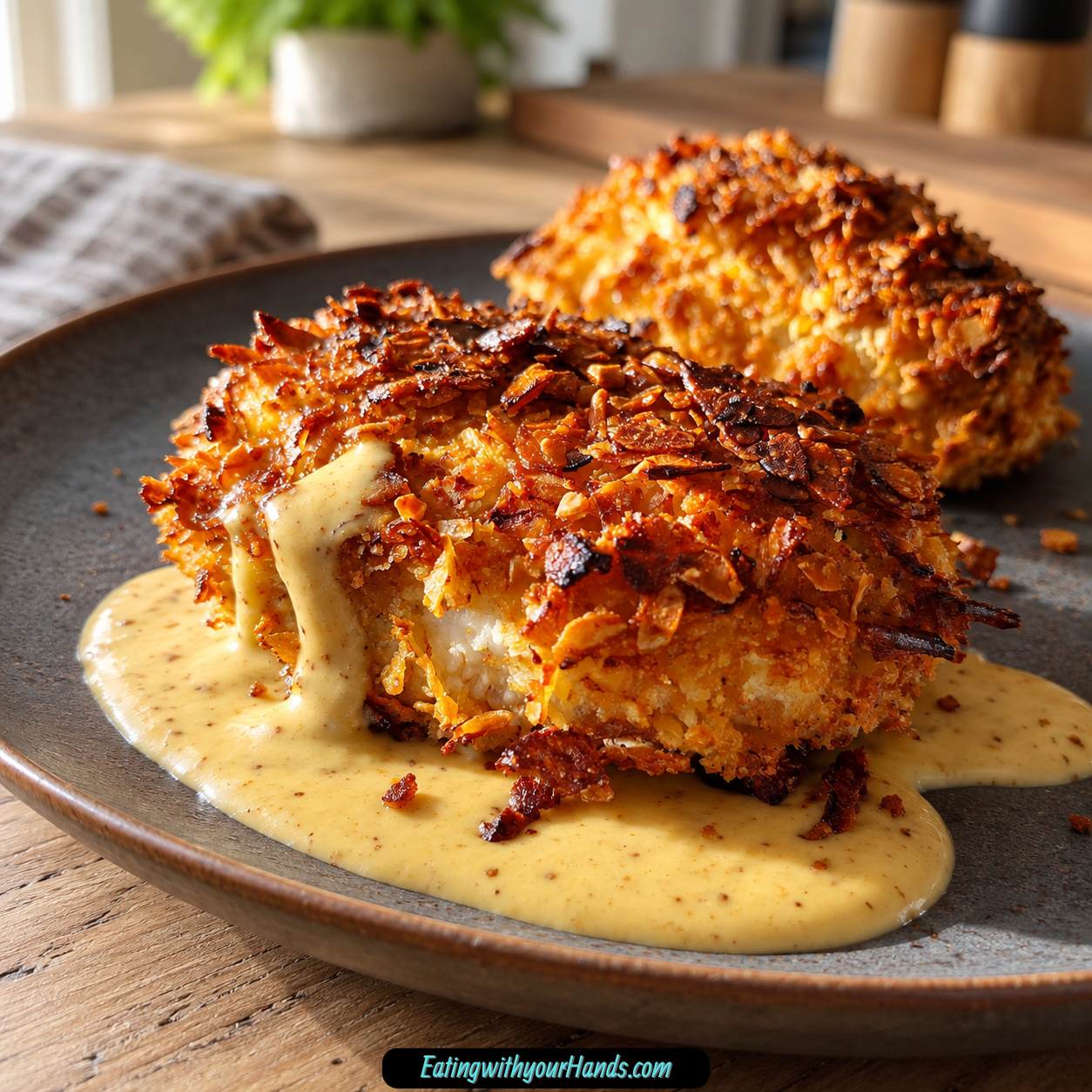

There are nights when chicken feels like the most practical answer to dinner and, at the same time, the least exciting one. That was exactly the mood I was in years ago when a desperate “what am I making tonight?” dinner turned into this Pretzel Chicken with Mustard-Cheddar Sauce.
What started as a way to make ordinary chicken feel less predictable quickly became one of those recipes I kept returning to. The combination of juicy chicken, a salty pretzel coating, and a warm cheddar sauce with Dijon mustard somehow makes a very familiar ingredient feel completely different.
The first thing you notice is the crunch. Each chicken breast gets coated in crushed pretzels, seared until golden, and then finished in the oven so the outside stays crisp while the center cooks through.
Then there is the sauce. Sharp cheddar and mustard turn a simple butter-and-flour base into something creamy, tangy, and rich enough to feel indulgent without overwhelming the chicken underneath.
That contrast is what makes the meal memorable. The pretzel coating is crisp and salty, the chicken stays juicy, and the sauce brings enough creaminess and sharpness to tie everything together.
It also has the kind of appearance that makes dinner feel more intentional than it really was. A golden pretzel crust with warm cheese sauce spooned over the top looks restaurant-worthy, even though the method is straightforward enough for a weeknight.
My picky nephew ended up loving it, which gave the dish another reason to stay in regular rotation. He started calling it “chicken nuggets for grown-ups,” and honestly, that description is not far off.
The recipe is playful enough to feel fun but substantial enough to serve to guests. It has become one of my favorite ways to turn a basic package of chicken breasts into something people actually talk about after dinner.
Table of Contents
- Why Pretzel Chicken with Mustard-Cheddar Sauce Works So Well
- Ingredients for Pretzel Chicken with Mustard-Cheddar Sauce
- Choosing and Preparing the Chicken
- Why the Pretzel Coating Is Different
- Equipment You’ll Need
- How to Make Pretzel Chicken with Mustard-Cheddar Sauce
- Step 1: Preheat the Oven
- Step 2: Pound the Chicken to Even Thickness
- Step 3: Season the Chicken
- Step 4: Prepare the Flour Bowl
- Step 5: Make the Egg Wash
- Step 6: Crush and Prepare the Pretzels
- Step 7: Dredge the Chicken in Flour
- Step 8: Dip the Chicken in Egg Wash
- Step 9: Press the Pretzel Crumbs Onto the Chicken
- Step 10: Let the Coated Chicken Rest Briefly
- Step 11: Heat the Vegetable Oil
- Step 12: Sear the First Side
- Step 13: Brown the Second Side
- Step 14: Arrange the Chicken for Baking
- Step 15: Bake for 15–20 Minutes
- Step 16: Confirm 165°F Internal Temperature
- How to Make the Mustard-Cheddar Sauce
- Tips for the Crispiest Pretzel Chicken
- How to Prevent Soggy Pretzel Coating
- Mustard-Cheddar Sauce Troubleshooting
- Mustard Substitutions
- Gluten-Free Pretzel Chicken
- Serving Suggestions
- Make-Ahead Tips
- How to Store Leftovers
- How to Reheat Pretzel Chicken
- How to Reheat the Mustard-Cheddar Sauce
- Pretzel Chicken with Mustard-Cheddar Sauce FAQs
- Nutritional Information
- The Dinner That Made Chicken Feel Exciting Again
- Pretzel Chicken with Mustard-Cheddar Sauce Recipe
Why Pretzel Chicken with Mustard-Cheddar Sauce Works So Well
The biggest reason is texture. Pretzels create a coating that feels completely different from ordinary breadcrumbs, with a more pronounced crunch and a little salty edge in every bite.
The chicken is also browned before it goes into the oven. That initial skillet step gives the crust a golden finish and builds flavor before the meat finishes cooking more gently on the baking sheet.
The sauce provides the opposite texture. While the crust is crisp, the cheddar sauce is smooth and velvety.
Dijon mustard keeps that sauce from becoming one-note. Its tang cuts through the richness of the cheese and butter and gives the finished plate a sharper, more balanced flavor.
Another advantage is timing. The meal can move from refrigerator to table in under 40 minutes, which makes it useful when you want something impressive without committing to a long cooking session.
And despite the finished appearance, there is nothing technically complicated here. The coating is simply flour, egg wash, and crushed pretzels, while the sauce follows a basic butter-flour-milk-cheese sequence.
Ingredients for Pretzel Chicken with Mustard-Cheddar Sauce
The ingredient list is familiar, but a few choices make a noticeable difference in texture.
For the Pretzel Chicken
- 4 boneless, skinless chicken breasts, about 6 oz each
- 2 cups crushed pretzel sticks
- ½ cup all-purpose flour
- 2 large eggs
- ¼ cup milk
- Salt and pepper
- 2 tablespoons vegetable oil
The chicken breasts should be pounded to an even ½-inch thickness before coating. This helps them cook at a more consistent rate from edge to center.
The pretzel sticks should be crushed into crumbs with some texture still remaining. Very large pieces tend to fall off, but turning everything into fine dust would remove part of what makes the coating interesting.
For the Mustard-Cheddar Sauce
- 2 tablespoons butter
- 2 tablespoons all-purpose flour
- 1 cup milk
- 1 cup shredded sharp cheddar
- 2 tablespoons Dijon mustard
- Salt and pepper
The cheddar should ideally be freshly grated. Freshly shredded cheese melts more smoothly than pre-shredded cheese, which can contain anti-caking ingredients that affect the texture.
The milk is best warmed slightly before it is added to the sauce. This helps it blend into the roux more smoothly and reduces the chance of lumps.
Choosing and Preparing the Chicken
Use 4 boneless, skinless chicken breasts at about 6 oz each. The most important preparation step is making them an even thickness.
Place each breast between two sheets of plastic wrap or parchment paper. Use a meat mallet or rolling pin to gently pound the chicken until it is about ½ inch thick.
This is not about flattening the chicken aggressively. The goal is simply to reduce thick and thin sections so the pieces cook more evenly.
Once the chicken is flattened, pat it dry if there is visible surface moisture. A dry surface gives the flour and egg wash a better chance of adhering.
Season both sides with salt and pepper shortly before coating. If time allows, the chicken can sit at room temperature for 10–15 minutes before cooking to help it cook more evenly.
Why the Pretzel Coating Is Different
Pretzels bring both flavor and texture to the crust. Their saltiness works especially well with the tangy cheese sauce.
Crush them enough that most pieces will cling to the chicken. A rolling pin and a bag are useful for breaking them down without turning them completely into powder.
Some texture is desirable. The coating should have enough small pieces to adhere well while still leaving a few slightly larger crumbs for extra crunch.
The pretzel layer comes last in a three-part coating process. Flour goes on first, then egg and milk, then the crushed pretzels.
That order matters because each layer helps the next one stick.
Equipment You’ll Need
The main equipment list is simple:
- Heavy skillet
- Rimmed baking sheet
- Meat mallet or rolling pin
- 3 shallow bowls
- Whisk
A cast-iron skillet is one preferred option for getting a strong sear on the pretzel crust. Any heavy skillet suited to stovetop browning can work.
The three shallow bowls create an easy coating station. One holds flour, one holds the egg-and-milk mixture, and one holds the crushed pretzels.
A wire rack placed over the baking sheet is also suggested as an optional technique when you want more airflow underneath the chicken during baking. It is not required for the basic method.
How to Make Pretzel Chicken with Mustard-Cheddar Sauce
The method works best when you prepare everything before the skillet gets hot. Have the chicken pounded, coating bowls ready, oven preheated, and baking sheet waiting nearby.
Step 1: Preheat the Oven
Set the oven to 375°F.
The chicken will only spend a few minutes per side in the skillet, so the oven needs to be ready before browning begins. Once the crust is golden, the chicken should move directly into the oven.
Prepare the rimmed baking sheet at this point as well. Lining it with foil is suggested for easier cleanup.
Step 2: Pound the Chicken to Even Thickness
Place the chicken breasts one at a time between two sheets of plastic wrap or parchment paper.
Use a meat mallet or rolling pin to gently pound each breast to about ½-inch thickness.
Work gradually rather than using very hard strikes. The purpose is even thickness, not tearing the meat.
Once all four breasts are prepared, pat them dry if needed. Surface moisture can work against a crisp coating.
Step 3: Season the Chicken
Season both sides of each chicken breast with salt and pepper.
Apply the seasoning just before coating so it stays directly against the chicken rather than getting lost in the breading station.
If you have the extra time, let the seasoned chicken sit at room temperature for 10–15 minutes. This is an optional step that can help the pieces cook more evenly.
Step 4: Prepare the Flour Bowl
Place ½ cup all-purpose flour in the first shallow bowl.
This is the first layer of the coating system. The flour creates a dry surface that helps the egg mixture cling more evenly.
Keep the layer light. Too much flour can make the crust heavy instead of crisp.
Step 5: Make the Egg Wash
In the second shallow bowl, beat 2 large eggs with ¼ cup milk.
Mix until the eggs and milk are fully combined.
This liquid layer acts as the bridge between the flour and pretzel crumbs. It needs to cover the chicken evenly without dripping excessively.
Step 6: Crush and Prepare the Pretzels
Place the crushed pretzel sticks in the third shallow bowl.
You need 2 cups crushed pretzel sticks. Crushing them in a bag with a rolling pin is an easy way to create mostly even crumbs.
Leave some texture rather than reducing the pretzels to powder. Avoid very large chunks because those are more likely to fall away from the chicken.
Step 7: Dredge the Chicken in Flour
Take one chicken breast and place it into the flour.
Coat both sides lightly, making sure the flour reaches the surface evenly. Shake away the excess.
The goal is not to create a visible thick flour crust. It is simply the base layer for the egg wash.
Repeat with each chicken breast as you work through the coating station.
Step 8: Dip the Chicken in Egg Wash
Move the floured chicken into the bowl containing the egg and milk mixture.
Turn it so both sides are coated. Lift the chicken and let the excess liquid drip back into the bowl.
Too much egg wash can make the coating slide around, so give it a moment to drain.
Then move directly into the pretzel crumbs.
Step 9: Press the Pretzel Crumbs Onto the Chicken
Lay the chicken in the crushed pretzels and press firmly.
Turn it over and repeat on the other side. Use your hands to encourage the crumbs to adhere across the entire surface.
Do not rush this step. The pretzel layer is responsible for the distinctive texture of the finished dish.
If part of the coating refuses to stick, press more pretzels onto that area. Another quick dip into the egg wash can also help when necessary.
Step 10: Let the Coated Chicken Rest Briefly
Place the coated chicken on a plate while you finish the remaining pieces.
If you want an extra-thick pretzel crust, let the first coating set for about 5 minutes. Then dip the chicken again in the egg mixture and pretzels.
This double-dip method is optional. It is specifically for anyone who wants a more intense pretzel coating.
Step 11: Heat the Vegetable Oil
Add 2 tablespoons vegetable oil to the heavy skillet.
Heat it over medium-high until the oil shimmers.
The skillet needs to be hot enough that the coating begins sizzling as soon as the chicken touches the surface. That quick reaction helps the crust brown instead of absorbing too much oil.
Step 12: Sear the First Side
Carefully place the coated chicken into the hot skillet.
Do not overcrowd the pan. If the pieces do not fit comfortably, work in batches.
Cook the first side for about 2–3 minutes. Leave it relatively undisturbed so the pretzel crust can develop color.
You are not trying to cook the chicken through at this stage. The goal is only to create a golden exterior.
Step 13: Brown the Second Side
Turn the chicken and cook the second side for another 2–3 minutes.
Again, look for a golden crust rather than complete doneness.
Handle the chicken carefully during flipping so you do not knock off the pretzel coating.
Once both sides have good color, transfer the chicken to the prepared baking sheet.
Step 14: Arrange the Chicken for Baking
Place the browned chicken breasts on the baking sheet with a little room between them.
For extra airflow underneath, the FAQ suggests using a wire rack over the baking sheet. This can help the bottom coating stay drier.
Either method can be used. The important thing is not stacking or crowding the chicken.
Step 15: Bake for 15–20 Minutes
Transfer the chicken to the 375°F oven.
Bake for 15–20 minutes.
The exact finishing time depends on the chicken, so do not rely only on the clock. The internal temperature needs to reach 165°F at the thickest part.
Avoid opening the oven repeatedly. Check near the end of the baking range when the chicken should be close to done.
Step 16: Confirm 165°F Internal Temperature
Use an instant-read thermometer in the thickest part of the chicken.
The chicken is finished when it reaches 165°F.
This is the most reliable doneness test given for the recipe. Avoid continuing to bake well past that point because overcooked chicken becomes dry.
Once the chicken is done, keep it ready while the sauce is finished.
How to Make the Mustard-Cheddar Sauce
The sauce can be prepared while the chicken is baking. This keeps the total cooking process efficient and gives you warm sauce ready at the same time as the chicken.
Step 17: Melt the Butter
Place 2 tablespoons butter in a saucepan over medium heat.
Let it melt completely.
Do not brown it. The butter is simply the base for the flour-thickened sauce.
Step 18: Whisk in the Flour
Add 2 tablespoons all-purpose flour to the melted butter.
Whisk continuously until the mixture is smooth.
Cook it for about 1 minute. The mixture should begin smelling slightly nutty.
This creates the roux that will thicken the milk.
Step 19: Add the Warm Milk Slowly
Slowly pour in 1 cup slightly warmed milk while whisking constantly.
Adding it gradually helps keep the sauce smooth.
Do not dump in the entire cup and walk away. Keep whisking so the milk blends into the roux instead of forming lumps.
Step 20: Cook Until the Sauce Thickens
Continue cooking and whisking over medium heat.
The sauce should thicken enough to coat the back of a spoon. This takes about 3–4 minutes.
Once it reaches that texture, remove the saucepan from the heat before adding the cheese.
This timing matters because excessive heat can make the cheese sauce grainy.
Step 21: Stir in the Sharp Cheddar
Add 1 cup freshly shredded sharp cheddar after the pan is off the heat.
Stir until the cheese melts into the sauce.
Freshly grated cheese is preferred because it melts more smoothly. Pre-shredded cheese may contain anti-caking ingredients that interfere with the texture.
Keep stirring until the sauce looks velvety and unified.
Step 22: Add the Dijon Mustard
Stir in 2 tablespoons Dijon mustard.
The mustard adds the tangy element that cuts through the richness of the cheese.
If you prefer a milder sauce, another suggestion is starting with 1 tablespoon mustard and adding more to taste.
Taste after mixing because the cheddar can mellow the sharpness of the mustard as the sauce sits.
Step 23: Season the Sauce
Add salt and pepper to balance the sauce.
Taste before making additional adjustments. The pretzel coating already brings some saltiness to the plate.
If you want more mustard character, you can add another small amount according to preference. One casual variation mentions sometimes adding an extra teaspoon.
Step 24: Serve the Chicken With Warm Sauce
Place the baked pretzel chicken on plates.
Spoon the warm mustard-cheddar sauce generously over the top or serve it alongside for dipping.
Adding the sauce immediately before serving helps preserve more of the pretzel crunch.
This is especially important if crisp coating is a priority. Leaving the sauce sitting on the chicken for a long period can soften it.

Tips for the Crispiest Pretzel Chicken
The difference between an excellent pretzel crust and a disappointing one usually comes down to moisture, crumb size, and heat.
Pat the Chicken Dry
Blot the chicken with paper towels before seasoning and coating.
Surface moisture makes it harder for the flour and egg layers to adhere cleanly.
This simple step supports a more stable crust from the beginning.
Do Not Crush the Pretzels Too Fine
You want crumbs, but not pretzel flour.
A mixture of finer pieces and small textured crumbs gives the coating more character.
Avoid giant chunks because they fall off more easily during searing.
Do Not Overcrowd the Skillet
Give each chicken breast enough room to contact the hot skillet properly.
Crowding can reduce browning and interfere with the crust.
If necessary, cook in batches. A better sear is worth the extra few minutes.
Use a Thermometer
Check for 165°F at the thickest point of the chicken.
This lets you stop cooking as soon as the chicken is done instead of leaving it in the oven until it dries out.
The crisp crust works best when the inside is still juicy.
Keep the Sauce Off Until Serving
Pour the sauce over the chicken immediately before eating.
If you want maximum crunch, serve the sauce on the side and dip each bite.
The sauce is delicious, but moisture will eventually soften any crisp coating.
How to Prevent Soggy Pretzel Coating
The first defense against sogginess is drying the chicken before coating it.
The second is avoiding an overcrowded skillet. A hot pan with enough room helps the pretzel layer sear instead of steaming.
The third optional technique is baking the chicken on a wire rack set over the baking sheet. Air can circulate underneath instead of leaving the bottom pressed against a flat surface.
Finally, do not cover the chicken in sauce too early. Wait until serving.
These details work together. None requires changing the basic recipe, but they help preserve the texture that makes the dish special.
Mustard-Cheddar Sauce Troubleshooting
A smooth sauce depends heavily on heat control.
Once the milk has thickened, remove the saucepan from the heat before adding the cheddar. Cheese exposed to excessive heat can turn grainy.
Freshly grated cheddar is another important detail. Pre-shredded cheese may not melt as evenly because of anti-caking ingredients.
If the sauce becomes too strongly mustard-flavored, one approach is beginning with only 1 tablespoon Dijon and adding more gradually.
If the sauce does turn grainy, a quick blend can help save the texture.
Mustard Substitutions
Dijon mustard creates the main version of the sauce, but there are several alternatives.
Whole grain mustard can be used when you want a different texture.
Another option is 1 teaspoon yellow mustard combined with 1 teaspoon honey. This creates a sweeter variation.
In a pinch, a dash of Worcestershire sauce can provide savory depth without making the sauce as mustard-forward.
These options change the character of the sauce, so choose according to the flavor you want rather than assuming they will taste identical to Dijon.
Gluten-Free Pretzel Chicken
Gluten-free pretzels can replace regular pretzel sticks.
Crush them the same way and use them as the outer coating.
The FAQ specifically notes that gluten-free pretzel sticks can work well enough that the finished crispy coating remains very similar.
Because the standard recipe also includes all-purpose flour, use the flour option appropriate to your own gluten-free needs if making a fully gluten-free version.
No other cooking-time changes are specified.
Serving Suggestions
Pretzel Chicken with Mustard-Cheddar Sauce is rich enough to pair especially well with simpler vegetable sides.
Roasted Brussels sprouts are one favorite. Their caramelized edges complement the salty crunch of the chicken.
Creamy mashed potatoes create a more comfort-food-focused plate. The mustard-cheddar sauce can be spooned over the potatoes as well.
A crisp green salad is another option. A lemony arugula mix provides freshness against the richer chicken and cheese sauce.
Buttery corn on the cob gives the meal a more casual, cookout-style feeling.
Garlic roasted carrots add sweetness that contrasts nicely with the tang of the mustard.
For a more dressed-up presentation, slice the chicken and arrange it over wilted greens with the sauce drizzled around the plate.
And on an ordinary weeknight, there is nothing wrong with serving it beside whatever vegetables you already have.
Make-Ahead Tips
Several components can be prepared in advance.
The chicken can be coated and refrigerated for a few hours before cooking.
Do not leave the coated chicken overnight. The pretzels can become mushy if they sit against the moist chicken too long.
The sauce reheats well and can be prepared separately when that makes dinner easier.
Because the recipe specifically notes that extra sauce is useful, making a double batch can be practical if you want some ready for another meal.
How to Store Leftovers
Cool the chicken and sauce before storing them.
Place them in separate airtight containers.
Refrigerate for up to 3 days.
Keeping the chicken separate from the sauce is important because the coating has a better chance of staying crisp.
Do not pour leftover sauce over all the chicken before refrigeration if you want to preserve the texture.
How to Reheat Pretzel Chicken
Avoid the microwave for the chicken because it can quickly soften the coating.
Instead, place the chicken on a baking sheet and heat it in a 350°F oven for 10–15 minutes, or until heated through.
For an extra touch of crunch, sprinkle additional crushed pretzels over the chicken before reheating.
This will not make leftovers identical to freshly cooked chicken, but it helps bring back more texture than microwaving.
How to Reheat the Mustard-Cheddar Sauce
Place the sauce in a saucepan over low heat.
Add a splash of milk to help restore the creamy consistency.
Stir gently while it warms.
No exact amount of milk is specified. Add only enough to loosen the sauce.
Avoid overheating. Gentle heat protects the cheese from separating or becoming grainy.
Pretzel Chicken with Mustard-Cheddar Sauce FAQs
Can I use gluten-free pretzels?
Yes.
Crush gluten-free pretzel sticks well and use them in place of regular pretzels.
They can create a similarly crisp coating.
If you need the entire recipe gluten-free, also choose the flour appropriate to your dietary needs.
How do I prevent the coating from getting soggy?
Pat the chicken dry before coating it.
Do not overcrowd the skillet while browning.
For additional airflow during baking, place the chicken on a wire rack over the baking sheet.
Most importantly, wait until right before serving to add the sauce.
Can I make this ahead?
Yes, but prepare the components separately.
The coated chicken can be refrigerated for a few hours before cooking.
Do not leave it coated overnight because the pretzel layer may become mushy.
The mustard-cheddar sauce can also be prepared ahead and reheated gently.
What can I use instead of Dijon mustard?
Whole grain mustard is one option.
Another variation uses 1 teaspoon yellow mustard plus 1 teaspoon honey.
A dash of Worcestershire sauce can also add savory depth when you want less mustard flavor.
Why did my sauce become grainy?
The cheese may have become too hot.
Remove the thickened milk sauce from the heat before stirring in the cheddar.
Use freshly grated cheese when possible because pre-shredded cheese may contain ingredients that affect melting.
If the sauce has already become grainy, a quick blend can help smooth it.
Can I make the sauce milder?
Yes.
Start with 1 tablespoon Dijon instead of adding the full 2 tablespoons immediately.
Taste the sauce after the cheese and mustard are combined, then add more mustard if desired.
How do I know the chicken is cooked?
Check the thickest part with an instant-read thermometer.
The internal temperature should reach 165°F.
Do not rely only on the browned crust because the chicken finishes cooking in the oven after searing.
Nutritional Information
The nutrition values are estimates and can vary according to the exact pretzels, cheese, milk, and other ingredients used.
One serving is described as 1 pretzel-crusted chicken breast with about ¼ cup mustard-cheddar sauce.
Per serving:
- Calories: around 450
- Fat: 22g
- Saturated fat: 8g
- Protein: 35g
- Carbohydrates: about 30g
- Sodium: 800mg
The pretzels contribute a significant amount of the sodium, while the cheese and butter account for part of the fat.
Ingredient substitutions can change these numbers.
The Dinner That Made Chicken Feel Exciting Again
I still remember that original night when I was staring at ordinary chicken and trying to figure out how to make dinner feel less predictable. I was not trying to invent a special occasion dish; I simply wanted something that did not feel like the same meal I had made a dozen times before.
The pretzels changed that immediately. Once they became a crunchy coating rather than a snack sitting in a bag, the chicken suddenly had personality.
Then the mustard-cheddar sauce turned the whole thing into something I wanted to make again. It had enough richness to feel comforting, but the Dijon gave it the sharp contrast the fried pretzel crust needed.
That combination is still what keeps the recipe interesting for me. The chicken is familiar, but the textures make it feel new.
It is also one of those dinners that adapts easily to real life. On a busy night, I serve it beside simple vegetables; when guests are coming over, I can add mashed potatoes, roasted Brussels sprouts, or a crisp salad and make the plate feel much more complete.
My nephew still thinks of it as grown-up chicken nuggets, and maybe that is part of the charm. It is fun enough for a picky eater but flavorful enough that adults do not feel like they are eating a children’s dinner.
The crust snaps when you cut into it, the chicken stays juicy inside, and the warm cheddar sauce settles into all the rough edges of the pretzel coating. Every element does something different, yet nothing about the preparation feels unnecessarily complicated.
That is why this Pretzel Chicken with Mustard-Cheddar Sauce has lasted in my kitchen for so long. It began as an answer to a frustrating dinner question, but it turned into the kind of recipe I now reach for when I want ordinary chicken to feel worth getting excited about.
Pretzel Chicken with Mustard-Cheddar Sauce Recipe

Crispy on the outside and tender inside, this Pretzel Chicken with Mustard-Cheddar Sauce pairs a crunchy pretzel crust with a rich, creamy cheddar sauce flavored with Dijon mustard. The chicken is browned first for color and texture, then finished in the oven before being served with the warm cheese sauce.
Recipe Details
- Prep Time: 15 minutes
- Cook Time: 25 minutes
- Total Time: 40 minutes
- Course: Main Dish
- Cuisine: American
- Servings: 4 servings
- Calories: 450 kcal
Ingredients
For the Pretzel-Crusted Chicken
- 2 tablespoons vegetable oil
- Salt and pepper to taste
- ¼ cup milk
- 2 large eggs
- ½ cup all-purpose flour
- 2 cups crushed pretzels
- 4 boneless skinless chicken breasts
For the Mustard-Cheddar Sauce
- Salt and pepper to taste
- 2 tablespoons Dijon mustard
- 1 cup shredded cheddar cheese
- 1 cup milk
- 2 tablespoons all-purpose flour
- 2 tablespoons butter
Instructions
Step 1: Prepare the Oven and Chicken
Preheat the oven to 375°F (190°C).
Pound the boneless skinless chicken breasts to an even thickness so they cook at a similar rate.
Step 2: Season the Chicken
Season both sides of the chicken breasts with salt and pepper to taste.
Set the seasoned chicken aside while you prepare the breading station.
Step 3: Set Up the Coating
Prepare three bowls.
Place the ½ cup all-purpose flour in the first bowl. Whisk the eggs with ¼ cup milk in the second bowl, and add the crushed pretzels to the third.
Step 4: Coat the Chicken
Coat each chicken breast first in the flour.
Dip it into the egg and milk mixture, then press it firmly into the crushed pretzels so the coating adheres well on all sides.
Step 5: Brown the Pretzel Crust
Heat the vegetable oil in a skillet.
Add the coated chicken breasts and brown them on both sides, developing a crisp, golden pretzel crust.
Step 6: Finish the Chicken in the Oven
Transfer the browned chicken to a baking sheet.
Bake for 15–20 minutes to finish cooking the chicken.
Step 7: Start the Mustard-Cheddar Sauce
While the chicken finishes baking, melt the butter in a saucepan.
Whisk in the 2 tablespoons all-purpose flour and cook for 1 minute.
Step 8: Add the Milk
Gradually pour in the 1 cup milk while whisking.
Continue whisking until the mixture becomes smooth.
Step 9: Add the Cheese and Mustard
Stir in the shredded cheddar cheese and Dijon mustard.
Continue stirring until the cheese has melted and the sauce is smooth and creamy.
Step 10: Season and Serve
Season the mustard-cheddar sauce with salt and pepper to taste.
Serve the pretzel-crusted chicken with the warm sauce spooned alongside or over the top.
Notes
- Use pretzel sticks or twists for crushing.
- Adjust mustard to taste.
- Serve with a side of roasted vegetables.
Serving Suggestions
Serve Pretzel Chicken with Mustard-Cheddar Sauce while the chicken is hot and the cheese sauce is still warm and creamy. The crunchy pretzel coating creates a salty, crisp contrast with the smooth cheddar and Dijon sauce.
This recipe makes 4 servings and works well as a hearty family dinner. Roasted vegetables can be served on the side as noted.
If you prefer a stronger mustard flavor, adjust the Dijon mustard to taste while keeping the original 2-tablespoon amount as the base measurement.
Storage
How to Store
The recipe does not provide a specific storage method or storage duration, so no exact storage time is added here.
Chicken Tip
Use 4 boneless skinless chicken breasts and pound them to an even thickness before seasoning and coating.
Pretzel Tip
Use 2 cups crushed pretzels for the coating. Pretzel sticks or twists can be used before crushing.
Flour Tip
Use ½ cup all-purpose flour for coating the chicken and a separate 2 tablespoons all-purpose flour for thickening the sauce.
Egg Mixture Tip
Whisk 2 large eggs with ¼ cup milk before dipping the floured chicken into the mixture.
Sauce Milk Tip
Use a separate 1 cup milk for the mustard-cheddar sauce.
Cheddar Tip
Stir 1 cup shredded cheddar cheese into the smooth milk mixture until completely melted.
Mustard Tip
Use 2 tablespoons Dijon mustard in the sauce. Adjust the mustard flavor to taste if desired.
Baking Tip
After browning the chicken in the skillet, bake at 375°F (190°C) for 15–20 minutes.
Serving Tip
Serve the chicken with the warm mustard-cheddar sauce and roasted vegetables on the side.

Fernando is the creator and writer behind the food blog Eating with your Hands. Living and working in cities like Paris, Barcelona, and Berlin, and being married to a Canadian foodie, has given Fernando a passion and interest in food and inspired him to run EWYH.