
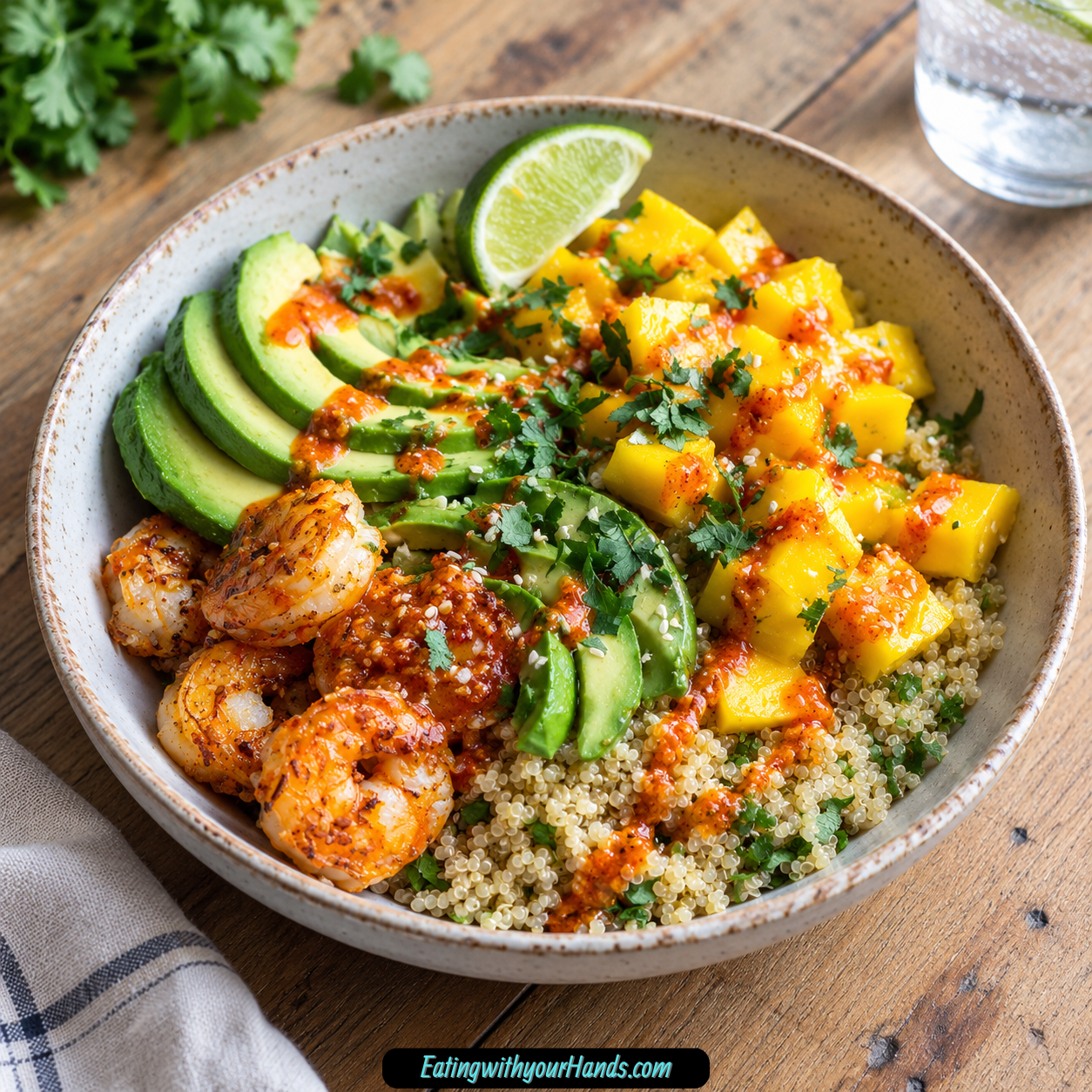

There are meals that feel practical, and then there are meals that somehow make an ordinary lunch feel like you escaped somewhere warmer for half an hour. These Shrimp and Avocado Bowls fall firmly into that second category for me.
Juicy shrimp, creamy avocado, sweet mango salsa, warm rice or quinoa, and a tangy lime-chili sauce all meet in one bowl. Every component is simple on its own, but together they create the kind of contrast that makes me slow down between bites instead of racing through lunch.
This recipe first happened almost by accident. One summer day, my refrigerator was nearly empty except for shrimp, a ripe avocado, and some leftover rice, so I started building a meal around what I had.
That improvised bowl ended up becoming something I wanted to make again almost immediately. Over time, mango salsa and the lime-chili sauce found their way into the routine, and what started as a fridge-cleanout meal turned into one of my most dependable lunches.
Now I make these bowls when I want something fresh enough to feel light but substantial enough to keep me satisfied for hours. The shrimp brings protein, the avocado adds richness, the grain base makes the bowl more complete, and the mango keeps every bite bright.
The sauce is the part that ties everything together. Greek yogurt, lime, chili powder, and a little honey create a creamy dressing that is tangy, gently spicy, and just sweet enough to balance the mango.
Another reason I keep coming back to this meal is how fast it is. From the first pan on the stove to the final drizzle of sauce, the whole thing comes together in about 25 minutes and stays comfortably under the 30-minute mark.
That means it works just as well for a quick weekday lunch as it does for a casual dinner or a relaxed date night at home. It looks colorful enough to feel special, but there is nothing complicated hiding behind that presentation.
Table of Contents
- Why Shrimp and Avocado Bowls Work So Well
- Ingredients for Shrimp and Avocado Bowls
- Choosing the Shrimp
- Choosing the Avocados
- How to Pick a Mango
- Why Lime Zest Matters
- How to Make Shrimp and Avocado Bowls
- Step 1: Prepare the Rice or Quinoa
- Step 2: Pat the Shrimp Dry
- Step 3: Heat the Skillet
- Step 4: Cook the First Side
- Step 5: Flip and Finish the Shrimp
- Step 6: Season the Shrimp Lightly
- Step 7: Dice the Mango
- Step 8: Add the Red Onion
- Step 9: Prepare the Jalapeño
- Step 10: Add Lime and Cilantro
- Step 11: Let the Mango Salsa Rest
- Step 12: Start the Lime-Chili Sauce
- Step 13: Add Chili Powder
- Step 14: Add Lime Zest and Juice
- Step 15: Sweeten the Sauce
- Step 16: Season the Sauce
- Step 17: Adjust the Sauce Consistency
- Step 18: Slice the Avocado
- Step 19: Build the Grain Base
- Step 20: Add the Shrimp
- Step 21: Add the Avocado
- Step 22: Spoon on the Mango Salsa
- Step 23: Drizzle With Lime-Chili Sauce
- Step 24: Garnish and Serve
- Why Shrimp Timing Matters
- How to Control the Jalapeño Heat
- Dairy-Free Sauce Options
- Other Sauce Substitutions
- Grain Variations
- Tips for the Best Shrimp and Avocado Bowls
- Make-Ahead Tips
- How to Store Leftovers
- Can You Use Frozen Shrimp?
- What to Do if the Mango Is Not Ripe
- Serving Suggestions
- Add Extra Crunch
- Frequently Asked Questions
- Can I use frozen shrimp?
- How should I store leftovers?
- Can I make the sauce dairy-free?
- Can I prepare these bowls ahead?
- What if my mango is not ripe?
- Can I use sour cream instead of Greek yogurt?
- Can I use something other than honey?
- Can I skip the mayonnaise?
- Can I use quinoa instead of rice?
- How do I make the salsa less spicy?
- How do I make it hotter?
- Shrimp and Avocado Bowls Nutritional Information
- The Accidental Bowl That Became a Weekly Favorite
- Irresistible Shrimp and Avocado Bowls Ready in 25 Minutes
Why Shrimp and Avocado Bowls Work So Well
The biggest reason is contrast.
The shrimp is warm, savory, and lightly seared. The avocado is cool and buttery, the mango salsa is juicy and bright, and the lime-chili sauce adds creaminess without making the bowl feel heavy.
There is also a balance of sweet and savory flavors. Mango and honey bring sweetness, while lime, chili powder, salt, pepper, red onion, and jalapeño keep the bowl lively.
Texture matters just as much. Rice or quinoa forms the soft base, shrimp adds firmness, avocado gives creamy richness, and mango salsa adds a fresh chopped texture.
The recipe is also easy to adjust. Rice can become quinoa, brown rice, or cauliflower rice, jalapeño can be increased or removed, and Greek yogurt can be replaced with sour cream or coconut yogurt.
Even the sweetener in the sauce can change. Honey, agave, maple syrup, or even a teaspoon of brown sugar in a pinch can all move the sauce slightly without changing the overall structure of the bowl.
Ingredients for Shrimp and Avocado Bowls
Fresh ingredients make the biggest difference here.
For the Bowls
- 1 lb large shrimp, peeled and deveined
- 1–2 ripe avocados, sliced just before serving
- 2 cups cooked rice or quinoa
The shrimp can have tails on or off depending on your preference.
Jasmine rice is a favorite base because of its fragrance, but quinoa works just as well when you want a different texture.
For the Mango Salsa
- 1 large ripe mango, diced into ¼-inch pieces
- ¼ cup finely diced red onion
- 1 small jalapeño, finely chopped
- Juice of 1 lime, about 2 tablespoons
- 1–2 tablespoons chopped fresh cilantro
- Pinch of salt
The jalapeño is optional but recommended.
Remove the seeds for less heat, or leave some or all of them in when you want a spicier salsa.
For the Lime-Chili Sauce
- ¼ cup plain Greek yogurt
- 1 tablespoon mayonnaise, optional
- 1 teaspoon chili powder
- Zest and juice of 1 lime
- 1 teaspoon honey or agave nectar
- Salt and freshly ground black pepper, to taste
Full-fat Greek yogurt gives the creamiest texture.
The mayonnaise is optional, but it makes the sauce a little richer and smoother.
For Garnish
- Extra cilantro leaves
- Lime wedges
Optional crunchy finishes include toasted sesame seeds or crushed peanuts.
Choosing the Shrimp
Use 1 pound large shrimp that have been peeled and deveined.
Tails can stay on for presentation or come off for easier eating. Either option works.
If you start with frozen shrimp, thaw them first.
One method is leaving them in the refrigerator overnight. Another is placing them in a bowl of cold water and changing the water every 15 minutes until they are thawed.
Once thawed, pat them very dry.
This is especially important with previously frozen shrimp because they tend to release more moisture. Excess moisture makes it harder to get a good sear in the skillet.
Choosing the Avocados
Use 1–2 ripe avocados.
Slice them only shortly before assembling the bowls so they stay green and fresh.
A ripe avocado should feel soft enough to slice easily but not so loose that it collapses.
The cool, creamy avocado is one of the main contrasts in the finished bowl, so keeping the slices intact is worth the extra care.
If your avocados are not ripe yet, one tip is storing them with a banana overnight.
Another suggestion is placing them in a paper bag with an apple to help speed ripening.
How to Pick a Mango
Use 1 large ripe mango.
Gently squeeze it the way you might test a ripe peach.
It should give slightly.
If it feels very hard, it is not ready. If it feels extremely soft, it may be overripe and harder to dice neatly.
The mango will be cut into ¼-inch pieces so the salsa stays easy to spoon across the bowl.
If fresh mango is unavailable, drained canned mango chunks can work in a pinch.
Peach slices are another backup option.
Why Lime Zest Matters
The lime-chili sauce uses both lime juice and lime zest.
Do not skip the zest.
The juice adds acidity, but the zest brings the stronger citrus aroma that makes the sauce taste especially fresh.
Roll the lime firmly on the counter before juicing.
That helps release as much juice as possible.
How to Make Shrimp and Avocado Bowls
The recipe works best when the components are prepared in a simple order. Cook the shrimp first while starting the salsa and sauce, then slice the avocado last and assemble everything while the shrimp is still warm.
Step 1: Prepare the Rice or Quinoa
Start with 2 cups cooked rice or quinoa.
If you are making it fresh, cook it according to the package directions.
Jasmine rice is a favorite choice, but quinoa, brown rice, or another listed grain base can work too.
Keep the base warm while you prepare the remaining components.
It does not need to be piping hot.
Step 2: Pat the Shrimp Dry
Place the 1 pound large peeled and deveined shrimp on paper towels or another absorbent surface.
Blot them thoroughly.
Drying the surface helps the shrimp sear better.
This is especially important if they were frozen.
Wet shrimp release extra moisture into the pan and can steam rather than sear.
Step 3: Heat the Skillet
Place a large skillet over medium-high heat.
Let it become properly hot before adding the shrimp.
The shrimp should begin cooking as soon as they hit the surface.
If the pan is not large enough to hold them comfortably, plan to cook in batches.
Crowding the skillet can lower the temperature and interfere with even cooking.
Step 4: Cook the First Side
Add the shrimp to the hot skillet.
Cook for about 2–3 minutes on the first side.
Do not move them constantly.
Give them enough time to begin turning pink and opaque.
You are looking for quick, even cooking rather than a long fry.
Step 5: Flip and Finish the Shrimp
Turn the shrimp.
Cook the second side for another 2–3 minutes.
The shrimp should be pink, opaque, and curled into clear “C” shapes.
That is your visual cue that they are ready.
Remove them as soon as they are cooked through.
Overcooking makes shrimp rubbery, so do not keep them in the pan just because the rest of the bowl is not ready yet.
Step 6: Season the Shrimp Lightly
Transfer the cooked shrimp to a plate.
Sprinkle lightly with salt.
Let them rest while you finish the salsa and sauce.
This keeps them ready for assembly without continuing to cook in the hot pan.
Step 7: Dice the Mango
Cut 1 large ripe mango into ¼-inch pieces.
Place the diced mango in a bowl.
Try to keep the pieces fairly even.
That makes the salsa easier to spoon and gives you a better mixture of flavors in each bite.
Step 8: Add the Red Onion
Finely dice ¼ cup red onion.
Add it to the mango.
The onion provides a sharper note that balances the fruit.
Keep the pieces small so they mix evenly through the salsa rather than dominating individual bites.
Step 9: Prepare the Jalapeño
Finely chop 1 small jalapeño.
Remove the seeds when you want a milder salsa.
Leave some or all of them in for more heat.
Add the jalapeño to the bowl.
If you prefer no heat at all, leave it out.
Step 10: Add Lime and Cilantro
Add the juice of 1 lime, about 2 tablespoons.
Add 1–2 tablespoons chopped fresh cilantro.
Sprinkle in a pinch of salt.
Gently stir everything together.
The salsa should taste bright, fresh, and slightly sweet.
Step 11: Let the Mango Salsa Rest
Let the salsa sit for at least 5 minutes.
That short rest gives the mango, onion, jalapeño, lime, cilantro, and salt time to blend.
For a cooler salsa with a softer onion bite, chill it in the refrigerator for about 15 minutes.
This creates an especially nice contrast against the warm shrimp.
Step 12: Start the Lime-Chili Sauce
In another bowl, add ¼ cup plain Greek yogurt.
Add 1 tablespoon mayonnaise if using.
Stir until smooth.
The mayonnaise is optional but adds extra richness.
Full-fat Greek yogurt creates the creamiest version.
Step 13: Add Chili Powder
Add 1 teaspoon chili powder.
Ancho chili powder is one favorite when available.
Stir until it is evenly incorporated.
The chili should add warmth without overwhelming the lime.
Step 14: Add Lime Zest and Juice
Zest 1 lime directly into the sauce.
Then add the juice of that same lime.
Mix thoroughly.
The zest is one of the most important flavor details because it gives the sauce a stronger citrus aroma.
Do not rely on the juice alone.
Step 15: Sweeten the Sauce
Add 1 teaspoon honey or agave nectar.
Stir until fully combined.
This small amount of sweetness balances the lime and chili.
Maple syrup can also replace the honey or agave.
A teaspoon of brown sugar is another emergency substitute.
Step 16: Season the Sauce
Add salt and freshly ground black pepper to taste.
Mix again.
Taste the sauce before adjusting further.
It should be creamy, citrusy, slightly sweet, and gently spicy.
Step 17: Adjust the Sauce Consistency
If the sauce is thicker than you want, add a splash of water.
Stir and check again.
Add only enough to make the sauce easy to drizzle.
You do not want it so thin that it runs straight through the bowl.
Step 18: Slice the Avocado
Do this right before assembly.
Run a knife around the avocado lengthwise.
Twist the halves apart and remove the pit.
Slice the flesh while it is still in the skin.
Then scoop the slices out carefully with a spoon.
Keeping the avocado intact until the last moment reduces browning.
Step 19: Build the Grain Base
Divide the warm rice or quinoa between bowls.
Spread it across the bottom.
This creates a foundation for the shrimp, avocado, salsa, and sauce.
The grain should support the toppings rather than overwhelm them.
Step 20: Add the Shrimp
Arrange the cooked shrimp over the rice or quinoa.
You can cluster them in one section or spread them around the bowl.
The visual arrangement is entirely up to you.
What matters is getting enough shrimp into each serving to balance the grain.
Step 21: Add the Avocado
Arrange the fresh avocado slices beside the shrimp.
Handle them gently.
Their cool creaminess is one of the key contrasts in the dish.
Keeping them in larger slices helps preserve that texture.
Step 22: Spoon on the Mango Salsa
Add a generous spoonful of mango salsa.
Try to include mango, onion, jalapeño, and cilantro rather than mostly fruit.
The salsa should sit brightly against the warm shrimp and grain base.
Its lime juice helps connect it to the sauce that will come next.
Step 23: Drizzle With Lime-Chili Sauce
Drizzle the lime-chili sauce generously over the bowl.
Do not be shy with it.
This sauce ties the shrimp, avocado, mango, and rice or quinoa together.
You can also serve a little extra alongside for anyone who wants more.
Step 24: Garnish and Serve
Finish with extra cilantro leaves.
Add lime wedges on the side.
A squeeze of fresh lime immediately before eating makes the bowl even brighter.
For extra crunch, sprinkle toasted sesame seeds or crushed peanuts on top.
Serve while the shrimp is still pleasantly warm and the avocado is fresh.

Why Shrimp Timing Matters
Shrimp cook very quickly.
A few extra minutes can be the difference between tender shrimp and rubbery shrimp.
Watch for the shape and color.
Once they are opaque and curled into “C” shapes, remove them from the heat.
There is no need to keep them cooking while you finish the other components.
Let them rest on a plate instead.
How to Control the Jalapeño Heat
The jalapeño is easy to adjust.
Remove all the seeds for a milder salsa.
Leave them in for more heat.
If you cannot decide, use about half the seeds.
That gives the salsa some warmth without committing to the full spice level.
If jalapeño is unavailable, a pinch of crushed red pepper can replace it.
You can also leave the heat out completely.
Dairy-Free Sauce Options
Greek yogurt can be replaced with coconut yogurt.
Expect the sauce to taste slightly sweeter.
Add an extra pinch of salt to help balance that sweetness.
Another option is tahini thinned with lime juice and a splash of water.
This produces a nuttier style of creamy sauce.
Both alternatives keep the creamy contrast that is important to the bowl.
Other Sauce Substitutions
Sour cream can replace Greek yogurt.
It gives the sauce a slightly richer character.
Honey can become agave or maple syrup.
A teaspoon of brown sugar is another practical substitute.
The mayonnaise is optional.
If serving guests, keep in mind that standard mayonnaise contains eggs.
Grain Variations
Rice is only one option.
Quinoa works well.
Brown rice can be used for a heartier grain texture.
Cauliflower rice is another alternative when you want a lighter base.
Frozen microwave rice packs are a practical shortcut for busy days.
The recipe is meant to work with real-life schedules, not require every component to be cooked from scratch.
Tips for the Best Shrimp and Avocado Bowls
A few small details make a big difference.
Use Fresh Lime Juice
Fresh lime juice is strongly preferred.
The brightness is difficult to replace with bottled juice.
Roll the lime before cutting to help release more liquid.
And remember that the zest belongs in the sauce too.
Dry the Shrimp Thoroughly
This matters especially with frozen shrimp.
Moisture makes searing more difficult.
Pat them dry before they touch the skillet.
The surface should not look wet.
Avoid Crowding the Pan
Cook the shrimp in batches if needed.
A crowded pan cools quickly.
Giving the shrimp space helps them cook more evenly.
Slice Avocado at the Last Minute
Do not prepare the avocado long before serving.
Cut it after the shrimp, salsa, and sauce are ready.
This helps preserve its color and texture.
Chill the Salsa When You Have Time
A 15-minute chill softens the bite of the onion and lets the flavors blend more fully.
The cold salsa also creates a pleasant contrast with warm shrimp.
This step is optional but especially nice when time allows.
Make-Ahead Tips
The recipe can be partially prepared in advance.
Cook the shrimp up to 2 days ahead.
Make the mango salsa up to 2 days ahead as well.
The sauce can also be prepared before serving and is described as becoming even better after chilling overnight.
Wait to slice the avocado until you are ready to assemble.
That is the one component that should remain completely fresh.
For meal prep, double the shrimp and salsa and build each bowl when you are ready to eat.
How to Store Leftovers
Keep the components separate in airtight containers.
Store the shrimp in one container.
Keep the mango salsa in another.
Leave the avocado unpeeled until serving.
The rice and sauce can be stored together if desired.
The components are described as staying fresh for 2 days, while another meal-prep note says they keep beautifully for about 2–3 days.
Use the freshest avocado only at the moment of assembly.
Can You Use Frozen Shrimp?
Yes.
Thaw overnight in the refrigerator or in cold water.
If using cold water, change the water every 15 minutes.
Once thawed, dry the shrimp thoroughly.
This is the most important step before cooking.
Then continue with the same skillet method.
What to Do if the Mango Is Not Ripe
If the mango is still very hard, it needs more time.
One option is placing it in a paper bag with an apple overnight.
If you cannot wait, use drained canned mango chunks.
Peach slices can also work in a pinch.
The goal is to keep that sweet fruit element in the bowl.
Serving Suggestions
Extra lime wedges are one of the easiest additions.
Let everyone squeeze more lime over their bowl at the table.
Tortilla chips are another favorite.
They are perfect for scooping up leftover mango salsa from the bottom of the bowl.
For a more elaborate side, serve a cucumber-jicama salad with chili-lime salt.
That adds more crispness and keeps the meal in the same fresh, bright direction.
Add Extra Crunch
Toasted sesame seeds can be scattered over the assembled bowl.
Crushed peanuts are another option.
Both add texture against the avocado and creamy sauce.
No exact amount is specified, so use according to preference.
Add these only at the end so they stay crunchy.
Frequently Asked Questions
Can I use frozen shrimp?
Yes.
Thaw them overnight in the refrigerator or in cold water.
If using the cold-water method, change the water every 15 minutes.
Pat the shrimp very dry before cooking.
Frozen shrimp release more moisture, so drying them well helps with searing.
How should I store leftovers?
Store the components separately in airtight containers.
Keep shrimp in one container and mango salsa in another.
Leave the avocado unpeeled until serving.
The rice and sauce can be stored together.
Most components stay fresh for about 2 days.
Can I make the sauce dairy-free?
Yes.
Use coconut yogurt instead of Greek yogurt.
Because coconut yogurt can taste slightly sweeter, add an extra pinch of salt.
Another option is tahini thinned with lime juice and a splash of water.
Can I prepare these bowls ahead?
Yes.
The shrimp and mango salsa can be made up to 2 days in advance.
Wait to slice the avocado and assemble until you are ready to eat.
The sauce can be made ahead and benefits from chilling overnight.
What if my mango is not ripe?
Use drained canned mango chunks or peach slices.
Another option is placing the mango in a paper bag with an apple overnight to help it ripen.
Can I use sour cream instead of Greek yogurt?
Yes.
Sour cream works well in the lime-chili sauce.
Use it in the same role as the yogurt.
Can I use something other than honey?
Yes.
Agave nectar or maple syrup both work.
A teaspoon of brown sugar can also be used in a pinch.
Can I skip the mayonnaise?
Yes.
The mayonnaise is optional.
It makes the sauce richer but is not required.
Can I use quinoa instead of rice?
Yes.
Quinoa is specifically recommended as an alternative.
Brown rice and cauliflower rice also work.
How do I make the salsa less spicy?
Remove the jalapeño seeds.
You can also use only part of the pepper.
If you want no heat at all, leave the jalapeño out.
How do I make it hotter?
Leave the jalapeño seeds in.
You can also use more of the pepper.
Adjust gradually so the mango still remains noticeable.
Shrimp and Avocado Bowls Nutritional Information
The nutrition values are estimates for one generous serving.
Per bowl:
- Calories: around 450
- Protein: about 25g
- Carbohydrates: about 45g
The shrimp and Greek yogurt contribute significantly to the protein.
The grain and fruit contribute much of the carbohydrate content.
The bowl also contains fats from the avocado and fiber from the mango and whole grains.
Exact values vary according to whether you use rice or quinoa, how much avocado goes into each bowl, how thickly the sauce is drizzled, and any additional toppings.
If you want to adjust the proportions, one suggestion is using more shrimp and vegetables and less rice.
The Accidental Bowl That Became a Weekly Favorite
I still think it is funny that this recipe started because my refrigerator looked almost empty.
There was no grand dinner plan and no carefully organized ingredient list. I just had shrimp, a ripe avocado, and leftover rice that needed somewhere to go.
Sometimes those are the meals that stick.
Once the mango salsa and lime-chili sauce became part of the routine, the bowl went from useful improvisation to something I actively looked forward to.
Now it is one of those meals I know I can rely on when I want freshness without feeling unsatisfied afterward.
The shrimp gives the bowl substance.
The avocado makes it creamy.
The mango adds that sweet tropical note that makes every forkful feel brighter than an ordinary lunch.
And then the sauce comes in with lime zest, chili, and just enough sweetness to connect all the pieces.
I love that the bowl can still change depending on the day.
Sometimes it sits over jasmine rice, sometimes quinoa, sometimes I leave the jalapeño mild, and sometimes I let the heat come through.
If I am serving other people, I might add lime wedges, extra cilantro, toasted sesame seeds, or crushed peanuts and make the whole thing look a little more polished.
If it is just lunch for me, I am perfectly happy eating it straight from the bowl with the salsa piled high and sauce drizzled everywhere.
Either way, the core feeling stays the same.
It is fresh, colorful, satisfying food that comes together quickly enough for a weekday but still feels like I did something nice for myself.
That is probably why the accidental combination never really left my kitchen.
It took one nearly empty refrigerator to discover it, but now these Shrimp and Avocado Bowls are exactly the kind of lunch I keep coming back to whenever I want something that tastes a little like sunshine.
Irresistible Shrimp and Avocado Bowls Ready in 25 Minutes

Fresh, colorful, and full of bright tropical flavor, these Shrimp and Avocado Bowls layer tender shrimp, creamy avocado, rice or quinoa, mango salsa, and a tangy lime-chili sauce. With sweet mango, fresh cilantro, lime, and optional jalapeño in every bowl, this fusion-style main course comes together in just 25 minutes.
Recipe Details
- Prep Time: 15 minutes
- Cook Time: 10 minutes
- Total Time: 25 minutes
- Course: Main Course
- Cuisine: Fusion
- Servings: 2 servings
- Calories: 450 kcal
Ingredients
For the Bowls
- Lime wedges for serving
- Fresh cilantro chopped (for garnish)
- 2 cups cooked rice or quinoa
- 1 large ripe mango diced
- 1 -2 ripe avocados sliced
- 1 lb large shrimp peeled and deveined
For the Lime-Chili Sauce
- Salt and pepper to taste
- 1 teaspoon honey or agave
- Zest and juice of 1 lime
- 1 teaspoon chili powder
- 1 tablespoon mayonnaise optional
- ¼ cup plain Greek yogurt
For the Mango Salsa
- Salt to taste
- 1 -2 tablespoon chopped fresh cilantro
- Juice of 1 lime
- 1 small jalapeño finely chopped optional
- ¼ cup diced red onion
- 1 diced mango
Instructions
Step 1: Cook the Shrimp
Place the peeled and deveined shrimp in a skillet over medium heat.
Cook for about 2–3 minutes per side, until the shrimp turn pink. Remove them from the heat and set aside.
Step 2: Prepare the Lime-Chili Sauce
Combine the plain Greek yogurt, optional mayonnaise, chili powder, lime zest, lime juice, honey or agave, salt, and pepper.
Mix until the sauce is smooth and evenly seasoned.
Step 3: Make the Mango Salsa
Combine the diced mango, diced red onion, finely chopped jalapeño if using, lime juice, chopped fresh cilantro, and salt.
Gently toss until the ingredients are evenly mixed.
Step 4: Start the Bowls
Divide the cooked rice or quinoa between 2 bowls.
Arrange the cooked shrimp and sliced avocado over the base.
Step 5: Add the Mango Components
Top the bowls with the prepared mango salsa.
The ingredient list also includes 1 large ripe mango diced in the main bowl ingredients; retain that listed mango as part of the bowl preparation according to the recipe quantities provided.
Step 6: Add the Sauce
Drizzle the lime-chili sauce over the assembled shrimp and avocado bowls.
Distribute the sauce according to preference between the 2 servings.
Step 7: Garnish and Serve
Finish with chopped fresh cilantro and lime wedges.
Serve immediately while the shrimp are fresh and the avocado and mango retain their texture.
Notes
- Use fresh ingredients for the best flavor.
- Adjust the spice level by adding more or less jalapeño.
- You can substitute Greek yogurt with sour cream.
Serving Suggestions
Serve Irresistible Shrimp and Avocado Bowls as soon as they are assembled. The warm shrimp, creamy avocado, sweet mango, fresh cilantro, lime, and chili-spiked sauce create a bright combination of flavors and textures.
This recipe makes 2 servings and can be built over either cooked rice or quinoa. Use 1–2 ripe avocados depending on how much avocado you prefer in each bowl.
For a spicier mango salsa, increase the jalapeño according to taste. If you prefer a different creamy base for the sauce, sour cream can replace the Greek yogurt as noted.
Storage
How to Store
The recipe does not provide a specific storage method or storage duration, so no exact storage time is added here.
Shrimp Tip
Use 1 lb large shrimp, peeled and deveined.
Cook over medium heat for about 2–3 minutes per side, until pink.
Avocado Tip
Use 1–2 ripe avocados, sliced, and add them directly to the assembled bowls.
Rice or Quinoa Tip
Use 2 cups cooked rice or quinoa as the base for the 2 servings.
Mango Tip
The ingredient list contains both 1 large ripe mango diced in the main bowl ingredients and 1 diced mango for the Mango Salsa.
Both listed amounts are preserved without combining them.
Sauce Tip
Mix ¼ cup plain Greek yogurt with optional mayonnaise, chili powder, the zest and juice of 1 lime, honey or agave, salt, and pepper.
Salsa Tip
Combine 1 diced mango, ¼ cup diced red onion, optional finely chopped jalapeño, juice of 1 lime, 1–2 tablespoon chopped fresh cilantro, and salt to taste.
Jalapeño Tip
Use 1 small jalapeño if desired.
Adjust the amount according to your preferred spice level.
Garnish Tip
Finish the bowls with chopped fresh cilantro and lime wedges before serving.

Fernando is the creator and writer behind the food blog Eating with your Hands. Living and working in cities like Paris, Barcelona, and Berlin, and being married to a Canadian foodie, has given Fernando a passion and interest in food and inspired him to run EWYH.