
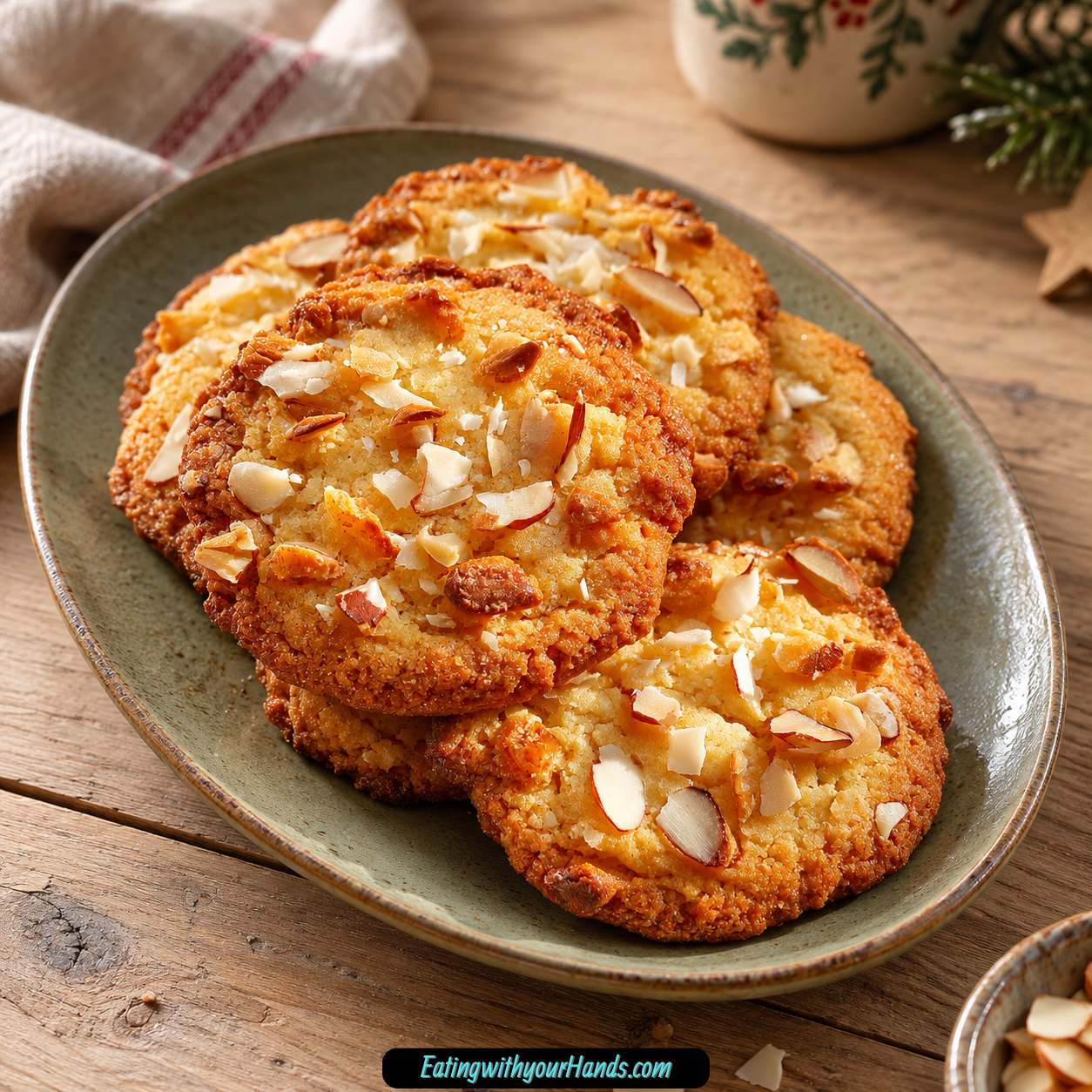

Every December, one of the clearest memories I have of Christmas is not a decoration or a wrapped present, but the smell drifting from my Oma’s small kitchen. Butter, vanilla, and almonds would fill the room long before the first tray of Traditional German Almond Christmas Cookies was cool enough to eat.
She would stand at the counter with flour on her hands and an old wooden rolling pin moving back and forth over the dough. While she worked, she told us stories about her own mother making the same cookies back in Bavaria, turning an ordinary afternoon of baking into something that felt connected to another place and another generation.
The almond aroma was always unmistakable. Even now, it takes very little for that scent to bring back the feeling of a cozy Christmas market and those December afternoons spent waiting for the next batch to come out of the oven.
What makes these cookies memorable is not only their flavor. They have crisp edges, tender centers, a buttery richness, and enough almond flavor to make each bite feel delicate rather than heavy.
Vanilla gives the dough sweetness and warmth, while the shaved almonds on top add another nutty layer. When baked until the edges are just beginning to turn golden, the cookies have that balance between firmness and tenderness that made Oma’s trays disappear so quickly.
After she passed away, I found her handwritten recipe card. It was stained with butter and vanilla extract, with edges softened and worn by decades of use.
That little card became more than a set of measurements. It was a piece of the ritual I had watched for years, and now these cookies are part of my own Christmas Eve with my kids.
Making them does not feel like recreating something complicated or formal. It feels like continuing a familiar rhythm: cream the butter, mix the dough, roll it to the right thickness, cut the shapes, scatter almonds over the tops, and wait for the first hint of gold around the edges.
That simplicity is part of why the recipe has lasted so well. There are no elaborate decorating techniques and no specialty equipment required, only a handful of dependable ingredients and careful attention to a few important details.
Table of Contents
- Why These Traditional German Almond Christmas Cookies Feel So Special
- Ingredients for Traditional German Almond Christmas Cookies
- Why Measuring the Almond Flour Carefully Matters
- Butter Temperature Makes a Difference
- Room-Temperature Eggs Help the Dough Come Together
- Equipment You’ll Need
- How to Make Traditional German Almond Christmas Cookies
- Step 1: Prepare the Baking Sheets and Ingredients
- Step 2: Cream the Butter and Sugar
- Step 3: Add the First Egg
- Step 4: Mix in the Second Egg
- Step 5: Add the Flour and Almond Flour Gradually
- Step 6: Add Vanilla, Baking Soda, and Salt
- Step 7: Stop Mixing as Soon as the Dough Comes Together
- Step 8: Chill the Dough for 30 Minutes if It Is Sticky
- Step 9: Prepare the Oven
- Step 10: Roll the Dough to 1 cm Thick
- Step 11: Cut the Cookie Shapes
- Step 12: Add the Shaved Almond Topping
- Step 13: Bake a Small Test Batch First
- Step 14: Bake the Full Trays
- Step 15: Cool the Cookies
- Tips for the Best German Almond Christmas Cookies
- Variations for Traditional German Almond Christmas Cookies
- Can You Use Whole Almonds Instead of Almond Flour?
- How to Serve Traditional German Almond Christmas Cookies
- How to Store German Almond Christmas Cookies
- Freezing the Cookie Dough
- Frequently Asked Questions
- Nutritional Information
- A Christmas Cookie That Carries More Than Almond Flavor
- Irresistible Traditional German Almond Christmas Cookies Recipe
Why These Traditional German Almond Christmas Cookies Feel So Special
The texture is probably the first thing people notice. The edges have enough crispness to give each cookie definition, but the centers stay tender rather than turning hard.
That contrast comes from several parts of the recipe working together. Softened butter is creamed thoroughly with sugar, almond flour brings richness, and the dough is rolled to about 1 cm instead of being made paper-thin.
The almond flavor also appears in more than one place. There are 250 g of almond flour in the dough and another 30 g of shaved almonds scattered over the cookies before baking.
Because the cookies are not overloaded with complicated additions, those flavors have room to stand out. Vanilla, almond, butter, and sugar create the main character of each bite.
They also have an elegant holiday appearance without requiring icing. A simple cut shape topped with shaved almonds and baked to a light golden color already looks festive enough for a Christmas cookie tray.
Another advantage is how approachable the recipe is. If you can cream butter, mix a dough, roll it, and use a cookie cutter, you already have the techniques you need.
That makes Traditional German Almond Christmas Cookies suitable for a relaxed holiday baking day rather than a stressful project. The details matter, but none of them require professional pastry skills.
Ingredients for Traditional German Almond Christmas Cookies
The specific measurements are important, especially for the flour and almond flour. Weighing the ingredients is recommended whenever possible because changing the amount of almond flour can noticeably affect the final texture.
- 500 g (about 4 cups) all-purpose flour
- 250 g (2 sticks) unsalted butter, softened
- 250 g (1¼ cups) granulated sugar
- 250 g (2½ cups) almond flour, packed
- 30 g (2 tbsp) vanilla sugar, or 1 teaspoon vanilla extract
- 2 large eggs, room temperature
- 2 teaspoons baking soda
- Pinch of fine sea salt
- 30 g (¼ cup) shaved almonds, for topping
There are no complicated seasonal ingredients hidden in the list. The holiday character comes from the combination of butter, vanilla, almonds, and the familiar ritual of rolling and cutting the dough.
Why Measuring the Almond Flour Carefully Matters
Almond flour has a major role in the texture of these cookies. The recipe uses 250 g, listed as about 2½ packed cups, and the weight is the more dependable measurement when precision matters.
Too much or too little changes the balance of the dough. That is why weighing both the regular flour and almond flour is one of the most useful habits for this particular cookie.
The almond flour does more than contribute flavor. It is part of what gives the center its rich, delicate quality next to the lightly crisp edges.
Store-bought almond flour also gives a more consistent result than grinding whole almonds yourself. Whole almonds can be used in a pinch, but they need to be processed extremely finely with the flour.
Butter Temperature Makes a Difference
The 250 g unsalted butter should be softened before you begin. The ideal texture is soft enough to leave a slight indent when pressed, but still firm enough to hold its shape.
Butter that is too cold will resist creaming and will not blend smoothly with the sugar. Butter that becomes excessively warm can cause the cookies to spread more than intended.
That middle ground is worth paying attention to. It gives you butter that can become light and fluffy during the creaming stage without turning oily or loose.
Room-Temperature Eggs Help the Dough Come Together
The recipe uses 2 large eggs at room temperature. They are added one at a time after the butter and sugar have been thoroughly creamed.
Cold eggs can cause the softened butter mixture to seize or separate. Giving them time to lose their refrigerator chill allows them to blend more smoothly.
You do not need to add them together. Mixing well after each egg keeps the dough base more uniform before the dry ingredients arrive.
Equipment You’ll Need
The tool list is deliberately simple:
- Large mixing bowl, or a stand mixer
- Wooden spoon or hand mixer
- Baking sheets lined with parchment paper
- Rolling pin
- Cookie cutters, or a glass for circles
A wooden spoon is completely sufficient for creaming if you enjoy mixing by hand. A hand mixer or stand mixer can reduce the effort, but none of those tools change the basic method.
Parchment-lined baking sheets are recommended rather than greasing the pans. The parchment creates an easy surface for transferring and baking the shaped dough.
Cookie cutters can be as festive as you want. Stars and trees are favorite holiday shapes, while a plain drinking glass works perfectly well when simple circles are more your style.
How to Make Traditional German Almond Christmas Cookies
The dough is uncomplicated, but the best texture depends on giving each stage enough attention. Cream the butter properly, add the eggs gradually, stop mixing when the dough comes together, and keep the rolled thickness close to 1 cm.
Step 1: Prepare the Baking Sheets and Ingredients
Line your baking sheets with parchment paper before mixing the dough. Having the pans ready means shaped cookies can move directly onto the sheets without interrupting the process.
Measure the flour, almond flour, sugar, vanilla sugar or vanilla extract, baking soda, salt, and shaved almonds as well. Accurate measurements make the mixing stage much smoother.
Make sure the butter is softened and the eggs are at room temperature. These two temperature details matter more than they might seem in such a simple dough.
Step 2: Cream the Butter and Sugar
Place the 250 g softened unsalted butter and 250 g granulated sugar in the large mixing bowl. Beat them together until the mixture becomes pale, fluffy, and noticeably lighter in texture.
With a mixer, give this stage about 3–4 minutes. A wooden spoon works too, although it takes more physical effort.
Do not rush because the creaming stage creates the lightness that contributes to the finished cookie texture. When properly creamed, the mixture should look almost whipped and hold small peaks when lifted with a spoon.
Step 3: Add the First Egg
Add one of the 2 room-temperature eggs to the creamed butter and sugar. Mix until it has blended into the mixture rather than leaving visible streaks.
Adding eggs separately helps prevent the butter mixture from curdling. It also gives each egg time to become fully incorporated.
Once the first egg disappears into the mixture, move on to the second. There is no benefit to speeding through this stage.
Step 4: Mix in the Second Egg
Add the second egg and mix again until the base looks smooth. If the eggs are properly at room temperature, they should combine more easily with the softened butter.
You are building the wet foundation before introducing the dry ingredients. Once this mixture looks even, you can begin adding the flour and almond components.
Avoid prolonged beating after the eggs are incorporated. The most important extended mixing has already happened during the butter-and-sugar creaming stage.
Step 5: Add the Flour and Almond Flour Gradually
Begin mixing in 500 g all-purpose flour and 250 g packed almond flour. Add them gradually rather than dumping everything in and aggressively stirring.
The almond flour is essential to the signature almond flavor and tender texture. Keep the full amount rather than adjusting it by eye.
As the flour enters the bowl, the mixture will become much more dough-like. Work slowly enough that the dry ingredients are incorporated without unnecessary overmixing.
Step 6: Add Vanilla, Baking Soda, and Salt
Add 30 g vanilla sugar, or use 1 teaspoon vanilla extract if that is your chosen option. Add 2 teaspoons baking soda and a pinch of fine sea salt as well.
Continue mixing only until these ingredients are distributed through the dough. You do not need to keep beating once the mixture looks uniform.
The vanilla supports the almond flavor without competing with it. The finished cookies should have a clear balance of buttery sweetness, vanilla, and nuts.
Step 7: Stop Mixing as Soon as the Dough Comes Together
Pay attention to the moment when no obvious streaks of flour remain. That is your signal to stop.
Too much mixing can make cookies tougher than intended. The goal here is a dough that is combined, soft, and workable rather than one that has been beaten extensively.
It should still feel slightly soft at this stage. That does not mean additional flour is automatically necessary.
Step 8: Chill the Dough for 30 Minutes if It Is Sticky
If the dough feels too soft or sticky to roll cleanly, chill it for 30 minutes. Warm kitchens can soften butter-based dough enough that this extra step becomes useful.
There is no need to chill automatically if the dough already handles well. Use the 30-minute rest specifically when the texture makes rolling difficult.
After chilling, the butter should firm enough to make the dough easier to control. You can then continue with rolling and cutting.
Step 9: Prepare the Oven
Preheat the oven to 180°C (350°F). Give it enough time to reach the correct temperature before the first tray goes in.
Because oven behavior can vary, the recipe recommends baking a small test batch first. Two or three cookies are enough to learn whether your oven reaches the ideal color closer to 12 minutes or 15 minutes.
That small test can save an entire tray from becoming too crisp. It is especially useful the first time you make these cookies in a particular oven.
Step 10: Roll the Dough to 1 cm Thick
Place the dough on your rolling surface and roll it to approximately 1 cm thickness. Try to keep the thickness reasonably even across the sheet of dough.
Do not intentionally roll it thinner in an attempt to create more cookies. Thin dough will crisp much more strongly and move away from the tender-centered texture intended here.
The 1 cm thickness is one of the details that helps preserve the contrast between golden edges and softer centers. Take your time rather than rushing through the rolling stage.
Step 11: Cut the Cookie Shapes
Use your favorite cookie cutters to cut shapes from the rolled dough. Stars and Christmas trees are favorite seasonal options.
If you do not have cookie cutters, use a glass to cut simple circles. Oma would have considered that perfectly acceptable.
Transfer each cut cookie carefully to the parchment-lined baking sheet. Arrange them neatly enough that they can bake without being pressed against one another.
Step 12: Add the Shaved Almond Topping
Sprinkle the shaped cookies generously with the 30 g shaved almonds. Try to give each cookie some almond topping rather than placing most of it on only a few pieces.
The topping reinforces the nutty flavor already provided by the almond flour. It also gives the cookies their simple, elegant appearance.
There is no need for complicated decoration beyond this. The baked almond slices and golden edges provide all the finish these cookies need.
Step 13: Bake a Small Test Batch First
Place 2–3 prepared cookies in the oven before committing the full tray. Bake them within the recommended 12–15 minute range.
Watch specifically for the edges to begin turning golden. The centers may still look somewhat soft when the cookies are ready to come out.
Use that small batch to understand how quickly your oven bakes the dough. Once you know the right timing, continue with the larger trays.
Step 14: Bake the Full Trays
Bake the shaped cookies at 180°C (350°F) for 12–15 minutes. Look for lightly golden edges rather than waiting for the centers to become dark or visibly crisp.
The center should still appear soft when the tray comes out. That is not underbaking; the cookies continue firming during cooling.
If your oven has hot spots, rotate the pans halfway through baking. This helps create more even browning across the tray.
Step 15: Cool the Cookies
Transfer the baked cookies to a wire rack and let them cool. As they lose heat, the soft centers become more structured while retaining their tender character.
Do not judge the final texture while they are still hot. The cooling stage is part of what gives the cookies that crisp-edge, tender-center balance.
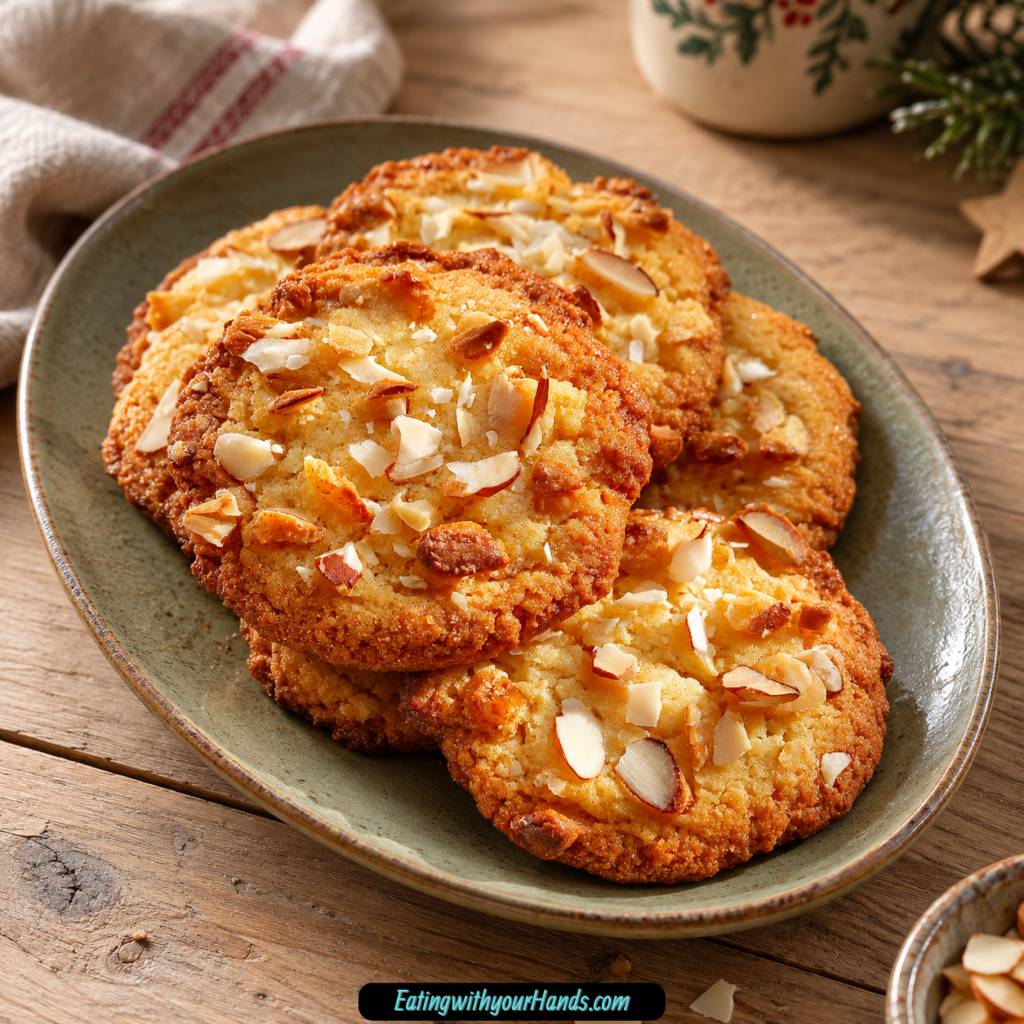
Once completely cool, they are ready to serve or store. Their almond aroma becomes especially noticeable as a full batch cools together.
Tips for the Best German Almond Christmas Cookies
The recipe itself is uncomplicated, but a handful of details have an outsized effect on the final result. These are the habits that keep the dough easy to work with and the finished cookies tender.
Pay Attention to Butter Temperature
Butter should be softened, not cold and not partially melted. Press it lightly and look for a small indent while the butter itself continues holding its form.
Too-cold butter will not cream properly. Too-warm butter makes the dough softer and encourages spreading.
Use Room-Temperature Eggs
Leave the eggs out while organizing the remaining ingredients so they have time to warm. They will blend more smoothly into the creamed butter mixture.
Very cold eggs can shock the softened butter and interfere with that smooth texture. This is an easy step to manage simply by planning ahead.
Do Not Overmix
After the dry ingredients go in, stop once the dough comes together. More mixing does not make the cookie better.
A tender center is part of the goal, and unnecessary mixing can move the texture toward toughness. Let the ingredients do their work without overworking them.
Chill Only When Needed
If the dough becomes sticky because your kitchen is warm, refrigerate it for 30 minutes. This makes rolling much easier.
The chill is a practical correction for soft dough rather than an automatic requirement. If the dough already rolls cleanly, you can move directly to shaping.
Keep the 1 cm Thickness
Thinner is not necessarily better with these cookies. Rolling to roughly 1 cm helps maintain the intended texture.
Too-thin pieces can become overly crisp in the oven. The slightly thicker shape gives the centers room to stay tender.
Rotate for Even Browning
If your oven bakes unevenly, rotate the pans halfway through. This is especially useful when one side of the oven tends to brown baked goods faster.
You are looking for a similar light-golden edge across the whole batch. Even color generally means more consistent texture from cookie to cookie.
Variations for Traditional German Almond Christmas Cookies
The classic almond version is the one tied most closely to my family Christmas memories, but the dough is flexible enough to support a few thoughtful variations.
Hazelnut Flour Variation
Almond flour can be replaced with hazelnut flour for a richer, nuttier flavor. Keep the same weight measurement when making the substitution.
Using weight here is particularly important because different nut flours can settle differently in measuring cups. Matching the weight protects the balance of the dough.
Add Citrus Zest
Orange zest or lemon zest can be added to the dough for a brighter flavor. Citrus cuts through some of the richness of the butter and nuts.
No exact amount is specified, so this is a variation to adjust according to preference. The main almond-cookie structure remains unchanged.
Use Almond Extract
Replace the vanilla sugar with ½ teaspoon almond extract when you want the almond character to become more intense. This creates a stronger nut-focused cookie.
Keep the substitution to the specified ½ teaspoon. Almond extract becomes a deliberate variation rather than an additional ingredient layered on top of the vanilla sugar.
Make Them Gluten-Free
Replace the all-purpose flour with a 1:1 gluten-free flour blend. The almond flour remains in the dough and helps support the texture.
This variation keeps the same overall cookie concept while changing the flour component. Use the same baking approach and watch the doneness cues carefully.
Can You Use Whole Almonds Instead of Almond Flour?
Whole almonds can technically be used, but the result will not have quite the same melt-in-your-mouth consistency. Store-bought almond flour is preferred because its fine texture is more consistent.
If whole almonds are your only option, pulse them with the flour in a food processor until the mixture becomes very fine. The closer you can get to almond-flour texture, the better the result will match the intended cookie.
Avoid leaving obvious coarse almond pieces in the flour mixture. Those pieces would change the texture from the delicate result associated with these cookies.
How to Serve Traditional German Almond Christmas Cookies
These cookies feel completely at home on a Christmas cookie tray. Their simple golden appearance and sliced almond topping look festive without requiring icing or colored decorations.
Strong coffee is one of the classic ways I like to serve them. The buttery almond flavor pairs naturally with a bold cup, just as Oma used to serve them at Christmastime.
Spiced tea is another fitting choice. The warm drink beside a crisp-edged almond cookie captures the cozy feeling that makes this recipe so connected to December for me.
They also work beautifully as part of a holiday gift. Because they store well, you can bake them ahead rather than trying to prepare every Christmas treat on the same day.
How to Store German Almond Christmas Cookies
Cool the cookies completely before transferring them to an airtight container. Place parchment paper between the layers so the cookies stay separated.
They are described as keeping fresh for weeks, with the more specific FAQ guidance giving about 2 weeks for maintaining their ideal texture in an airtight container. Store them at room temperature.
For maximum crispness, one suggested storage trick is placing a slice of bread in the container to absorb moisture. Keep the cookies covered and return the lid securely after serving.
The shaved almond topping may soften slightly after about day 5. If desired, a quick 5-minute warm-up in the oven can refresh the texture.
No reheating temperature is specified. Keep the warm-up limited to the supplied 5-minute duration rather than extending it unnecessarily.
Freezing the Cookie Dough
The dough can be frozen before rolling and baking. Shape the prepared dough into a disc and wrap it tightly in plastic.
Freeze it for up to 3 months. When you are ready to bake, move the dough to the refrigerator and let it thaw overnight.
Once thawed, roll and shape it according to the regular method. Oma actually preferred this approach because she believed the resting time improved the flavor.
Freezing dough can also make holiday preparation less rushed. You can complete the mixing stage well in advance and leave the rolling and baking for another day.
Frequently Asked Questions
Can I freeze Traditional German Almond Christmas Cookie dough?
Yes. Form the dough into a disc, wrap it tightly in plastic, and freeze it for up to 3 months.
Thaw it overnight in the refrigerator before rolling. After that, continue with the normal 1 cm thickness, cutting, almond topping, and baking.
Can I use whole almonds instead of almond flour?
Yes, although the cookie texture will be different. Almond flour gives more consistent results and contributes to the delicate, melt-in-your-mouth center.
If using whole almonds, process them with the flour until extremely fine. Leaving them coarse will move the texture further away from the intended result.
Stored in an airtight container at room temperature, they can maintain their ideal texture for about 2 weeks. The broader storage guidance describes them as staying fresh for weeks.
The shaved almond topping may begin to soften a little after day 5. A 5-minute warm-up in the oven can help refresh it.
What should I do if my dough is too sticky?
Refrigerate the dough for 30 minutes. This firms the butter and makes rolling easier in a warm kitchen.
Do not automatically compensate by adding unspecified extra flour. The dough is intended to feel somewhat soft before rolling.
Rolling the dough too thin is one possible reason. Keep it close to the recommended 1 cm thickness.
You should also remove the cookies when the edges are only beginning to turn golden and the centers still look somewhat soft. They will continue firming on the cooling rack.
How do I know exactly how long to bake them?
The recommended time is 12–15 minutes at 180°C (350°F). Because ovens vary, start with a test batch of 2–3 cookies.
Watch the edges rather than relying only on the clock. Once you know how your oven behaves, use that timing for the remaining trays.
Nutritional Information
The nutritional values are estimates and can change depending on ingredient brands and the size of the cookie cutters used.
Per cookie:
- Calories: 120
- Fat: 6g
- Carbohydrates: 15g
- Protein: 2g
Larger or smaller cookie shapes will naturally affect the amount in each serving. The ingredient choices and variations can also change these values.
A Christmas Cookie That Carries More Than Almond Flavor
I can make these cookies now without looking at every step the way I once did, but the process still brings me back to Oma’s kitchen. There is something about the butter becoming pale and fluffy, the soft dough under a rolling pin, and the smell of almonds in the oven that turns memory into something almost tangible.
I remember her flour-covered hands just as clearly as I remember the cookies themselves. I remember listening to her talk about her mother baking them in Bavaria and not fully understanding, as a child, how much history could be carried inside something as ordinary as a cookie recipe.
Finding that stained handwritten card after she was gone changed the meaning of the recipe for me. The marks of butter and vanilla and the worn edges showed just how many Christmases had already passed through those measurements.
Now my own kids are part of that story. Every Christmas Eve, the same dough gets mixed, rolled, cut, topped with almonds, and baked until those familiar golden edges appear.
That is why I never think of Traditional German Almond Christmas Cookies as simply another holiday dessert. Their buttery almond flavor matters, but so does the repetition of making them year after year.
A star might come out slightly crooked, one cookie may collect more shaved almonds than another, and a warm kitchen may force the dough into the refrigerator for half an hour. None of that takes away from what makes the batch meaningful.
The beauty of these cookies has always been in that balance between care and simplicity. There is enough precision to reward attention, but not so much that the tradition becomes intimidating.
So I cream the butter for those full few minutes, keep the dough about 1 cm thick, wait for the first trace of gold around the edges, and let the cookies finish firming on the rack. Somewhere in those familiar steps, the kitchen starts smelling like the Christmases I remember.
And when I finally sit down with one beside a strong coffee or spiced tea, I understand why this recipe has remained with my family for so long. It tastes of butter, vanilla, and almonds, but for me it also tastes unmistakably like Christmas Eve.
Irresistible Traditional German Almond Christmas Cookies Recipe

Buttery, nutty, and delicately flavored with almonds, these Traditional German Almond Christmas Cookies are crisp around the edges while staying tender inside. Almond flour, vanilla sugar, and shaved almonds give them a festive flavor and texture that make them especially suited to holiday baking.
Recipe Details
- Prep Time: 20 minutes
- Cook Time: 15 minutes
- Total Time: 35 minutes
- Course: Dessert
- Cuisine: German
- Servings: 30 -40 cookies
- Calories: 120 kcal
Ingredients
For the Cookie Dough
- Salt to taste
- 2 teaspoon baking soda
- 2 eggs
- 30 g vanilla sugar
- 250 g almond flour
- 250 g sugar
- 250 g unsalted butter
- 500 g all purpose flour
For the Topping
- 30 g shaved almonds for topping
Instructions
Step 1: Preheat the Oven
Preheat your oven to 180°C (350°F).
Have the baking sheet and parchment paper ready before you begin shaping the cookies.
Step 2: Cream the Butter and Sugar
In a large bowl, beat the unsalted butter and sugar together until light and fluffy.
Continue mixing until the two ingredients are thoroughly combined and the mixture has a soft, creamy consistency.
Step 3: Add the Eggs
Add the eggs one at a time.
Mix well after each addition so the eggs blend smoothly into the butter and sugar mixture.
Step 4: Add the Dry Ingredients
Gradually mix in the all-purpose flour, almond flour, vanilla sugar, baking soda, and salt to taste.
Work the ingredients in a little at a time until a cohesive dough begins to form.
Step 5: Knead the Dough
Knead the dough until smooth.
Continue only until the ingredients are evenly incorporated and the dough is ready to roll.
Step 6: Roll and Cut
Roll the dough out to approximately 1 cm thickness.
Cut it into your desired cookie shapes.
Step 7: Prepare for Baking
Line a baking sheet with parchment paper.
Arrange the shaped cookies on the prepared sheet, leaving enough room for them to bake evenly.
Step 8: Add the Almond Topping
Sprinkle the shaved almonds over the top of each cookie.
Distribute the 30 g of shaved almonds across the batch before placing the cookies in the oven.
Step 9: Bake
Bake for 12–15 minutes, or until the cookies are golden brown.
The recipe metadata lists a 15-minute cook time, while the baking instructions give a 12–15 minute range.
Step 10: Cool
Remove the cookies from the oven and transfer them to a wire rack.
Allow them to cool before serving so the texture has time to set.
Notes
- Store in an airtight container for up to 2 weeks.
- You can replace vanilla sugar with 1 teaspoon vanilla extract if needed.
- For extra flavor, add a pinch of cinnamon or nutmeg.
Serving Suggestions
Serve Irresistible Traditional German Almond Christmas Cookies Recipe once the cookies have cooled completely. Their buttery almond dough, crisp exterior, tender center, and shaved almond topping make them a festive choice for Christmas dessert trays and seasonal gatherings.
This recipe makes 30 -40 cookies, so it works well when preparing a larger holiday batch. Cut the rolled dough into any desired shapes while maintaining the recommended thickness of about 1 cm.
If vanilla sugar is unavailable, use the listed alternative of 1 teaspoon vanilla extract. For a warmer holiday flavor, a pinch of cinnamon or nutmeg can also be added as noted.
Storage
How to Store
Store the cooled cookies in an airtight container for up to 2 weeks.
Flour Tip
Use 500 g all purpose flour along with 250 g almond flour to form the base of the cookie dough.
Butter Tip
Use 250 g unsalted butter and cream it with 250 g sugar until light and fluffy.
Vanilla Tip
Use 30 g vanilla sugar in the dough. If needed, replace it with 1 teaspoon vanilla extract.
Almond Tip
Use 250 g almond flour in the cookie dough and 30 g shaved almonds for the topping.
Shaping Tip
Roll the dough to about 1 cm thickness before cutting it into your desired shapes.
Baking Tip
Bake at 180°C (350°F) for 12–15 minutes, or until golden brown.
Spice Tip
For extra flavor, add a pinch of cinnamon or nutmeg if desired.
Cooling Tip
Let the cookies cool on a wire rack before serving or storing.

Fernando is the creator and writer behind the food blog Eating with your Hands. Living and working in cities like Paris, Barcelona, and Berlin, and being married to a Canadian foodie, has given Fernando a passion and interest in food and inspired him to run EWYH.